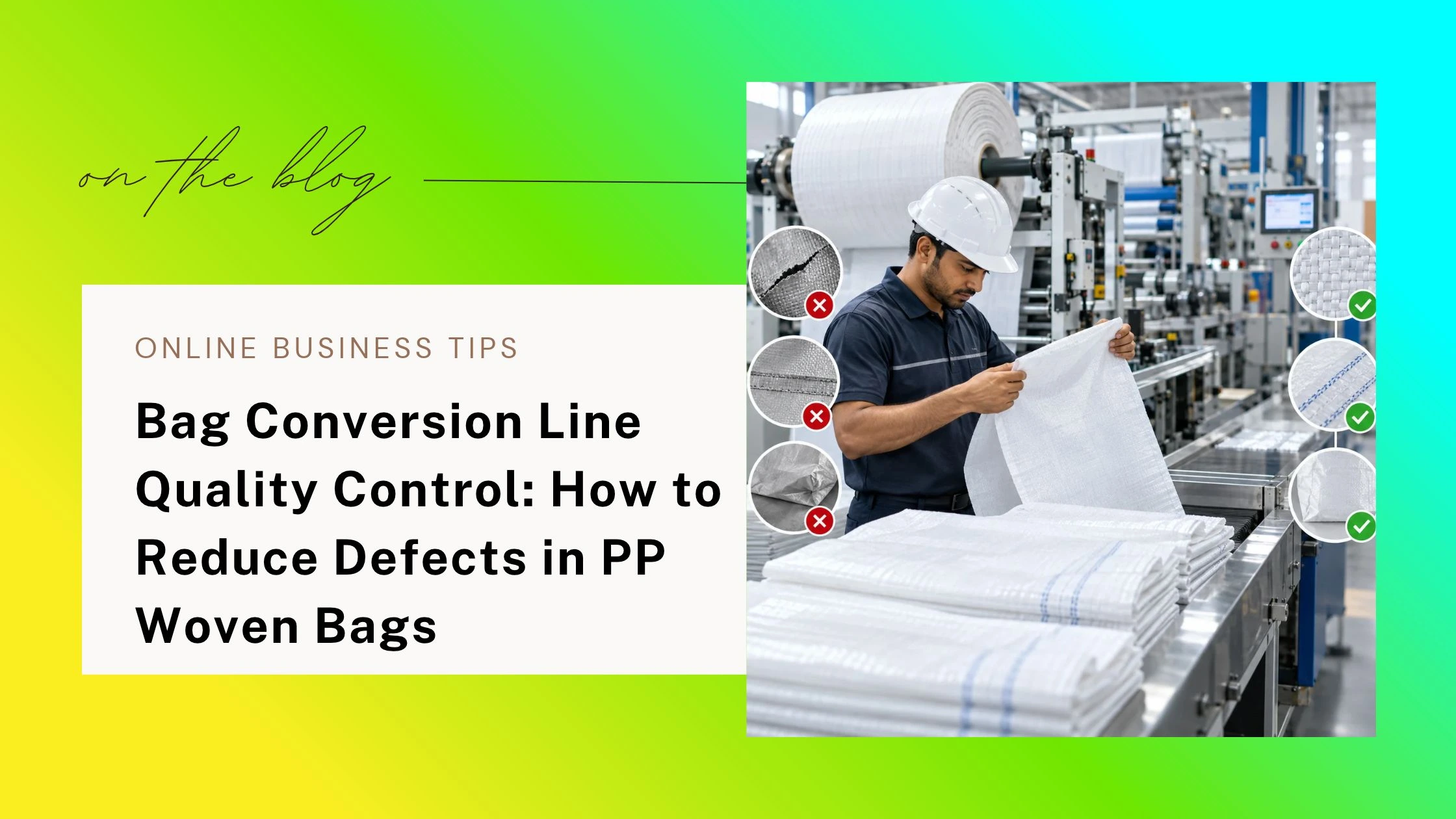
Bag Conversion Line Quality Control: Reduce PP Bag Defects
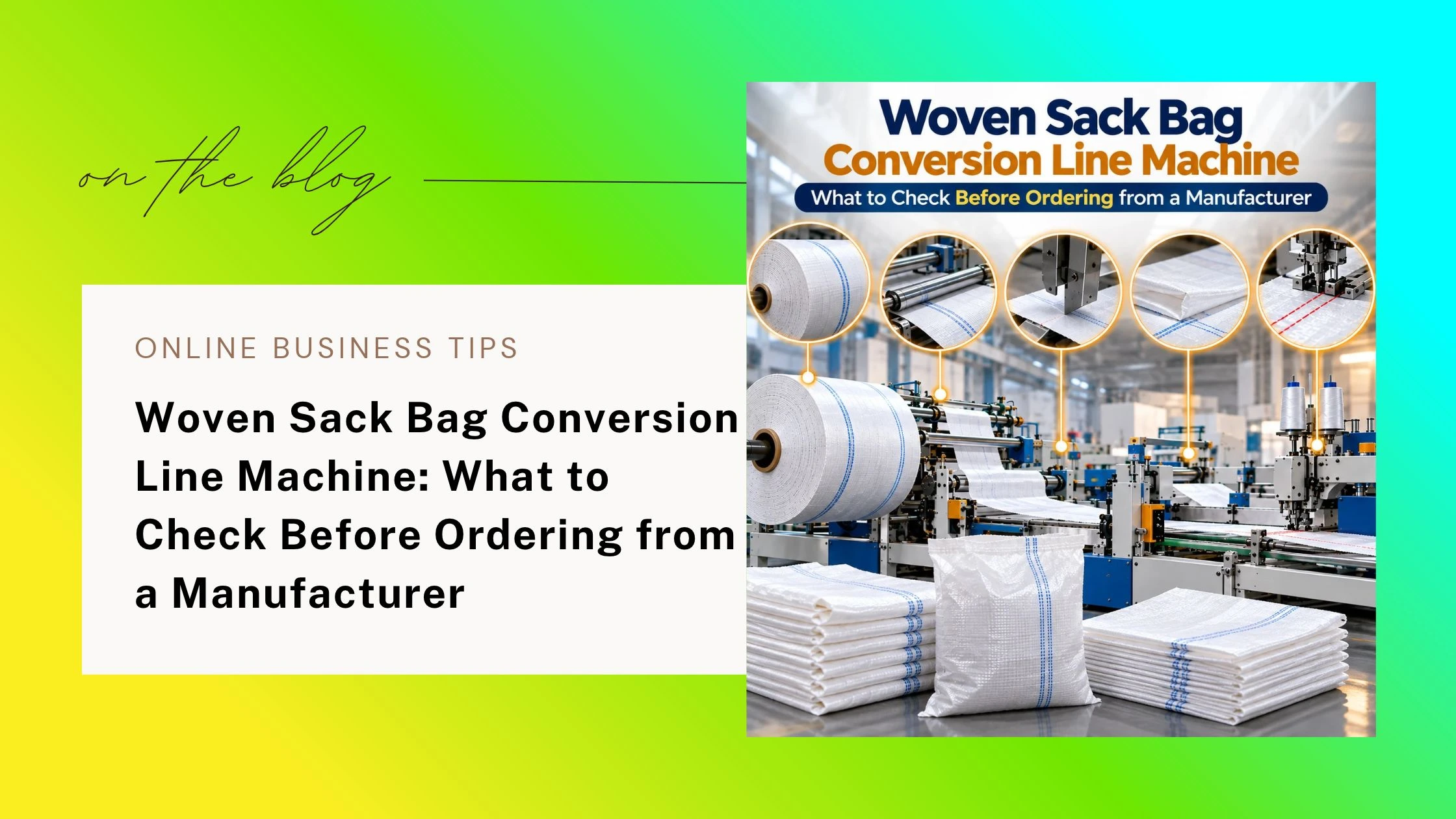
October 02, 2026
Buying a Woven Sack Bag Conversion Line Machine is not like ordering a standard piece of factory equipment from a catalogue. The machine becomes part of your production workflow, so its output, automation, compatibility, speed, bag dimensions and after-sales support can all affect your operation long after the purchase order is signed.
Whether you are producing PP woven sacks for fertiliser, grains, animal feed, chemicals, construction materials or industrial applications, the right conversion line needs to match your actual production requirements. A machine that looks impressive on paper may not be the right fit if its bag specifications, input material compatibility or production configuration do not match your factory.
That is why buyers should evaluate the complete woven sack production line, not simply compare machine prices. Before placing an international order, it is worth checking the machine's technical specifications, conversion process, automation level, production capacity, quality-control features, installation requirements and manufacturer support.
What Is a Woven Sack Bag Conversion Line Machine?
A Woven Sack Bag Conversion Line Machine converts woven polypropylene fabric into finished sacks or bags through a series of manufacturing operations. Depending on the configuration, the line can include fabric cutting, folding, stitching, printing, gusseting, bottom formation and other processes required for the final bag design.
The exact configuration depends on what the manufacturer needs to produce. A simple sack may require fewer operations than a printed, gusseted or specially finished industrial bag.
This is why buyers should define the finished bag before choosing the equipment. Bag length, width, construction, printing requirements, stitching pattern and production volume all influence which woven sack conversion machine configuration makes sense.
For manufacturers planning a new production line, the machine should be evaluated as an integrated system rather than as a collection of unrelated components.
What Should You Check Before Ordering a Woven Sack Conversion Machine?
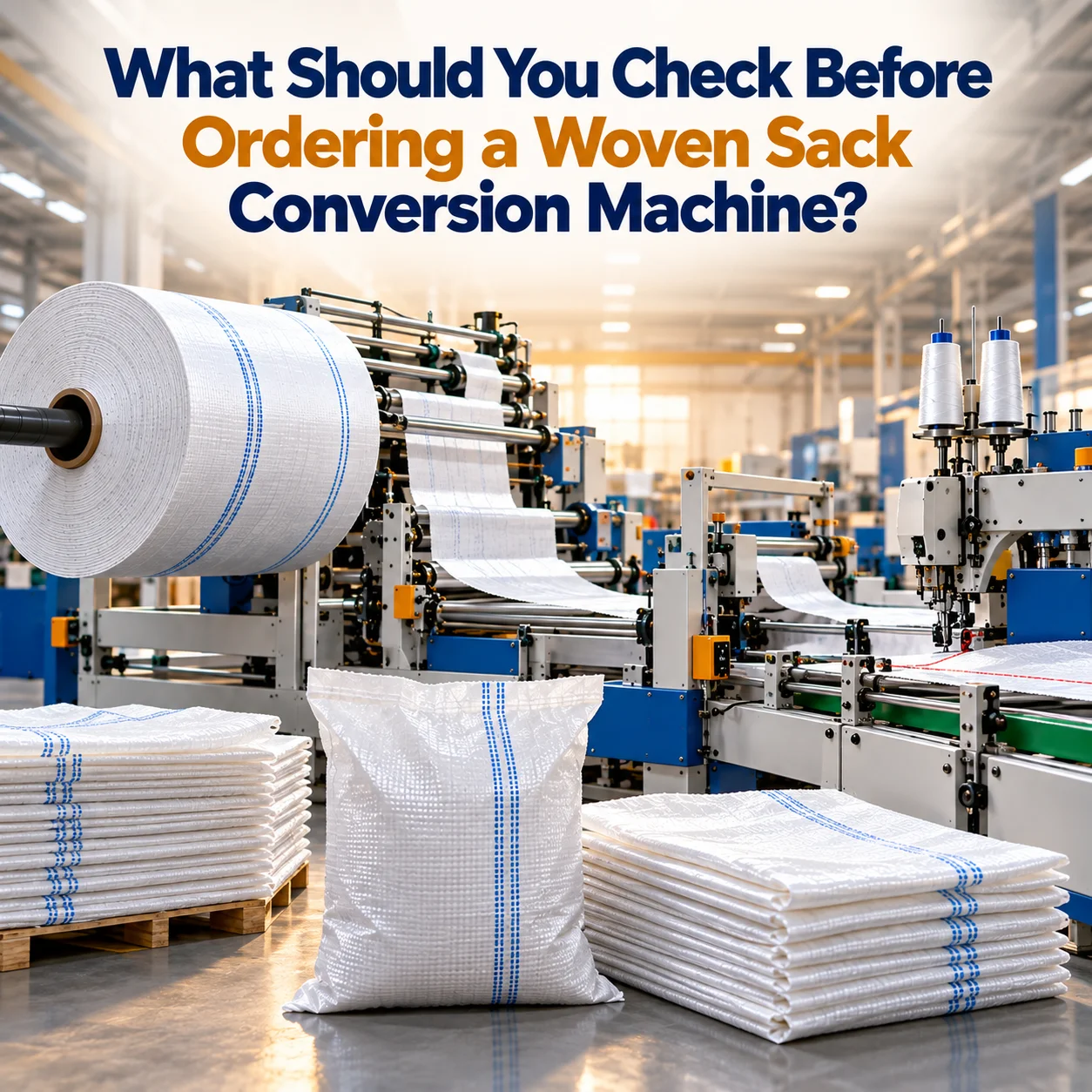
Before ordering a woven sack conversion machine, start with the finished product rather than the machine itself. The manufacturer needs to understand exactly what you intend to produce.
The following factors should be included in your technical discussion:
-
Bag specifications: Define bag width, length, gusset requirements, bottom construction and other dimensions.
-
Fabric compatibility: Confirm the PP woven fabric types, GSM range and fabric width supported by the equipment.
-
Production capacity: Establish the expected bags per minute or hourly output under the actual production conditions.
-
Automation: Determine which operations are automatic and which require operator intervention.
-
Cutting accuracy: Check how consistently the machine can cut bags to the required length.
-
Stitching quality: Confirm the stitching configuration and compatibility with your bag design.
-
Printing requirements: If printing is part of the production process, establish whether it is integrated or handled separately.
-
Changeover: Ask how quickly operators can change between different bag sizes or specifications.
-
After-sales support: Clarify installation, training, spare parts and technical assistance before purchasing.
A detailed specification sheet makes manufacturer comparisons much more meaningful than comparing headline machine prices.
Understand Your Woven Sack Production Requirements First
A woven sack production line should be selected according to production requirements, not simply according to the maximum speed advertised by a supplier.
Start by identifying your target monthly production volume. Then determine how many different bag sizes you expect to manufacture. If you frequently switch between sizes, changeover time becomes an important consideration.
For example, a manufacturer producing one standard sack in very large quantities may prioritise continuous production efficiency. Another manufacturer producing several bag sizes may place greater importance on flexibility and fast setup.
Your production model should therefore determine the equipment configuration.
Before contacting a woven sack machine manufacturer, prepare information about your target bag sizes, fabric specifications, production volume and finished-bag requirements.
Check the Machine's Fabric Compatibility
One of the most important technical checks is whether the equipment is compatible with the woven fabric you actually use.
A PP woven sack conversion machine may be designed around specific fabric widths, thicknesses, GSM ranges and material characteristics. If your incoming fabric falls outside those parameters, production quality or machine performance can be affected.
Ask the manufacturer to confirm:
-
Compatible fabric width
-
GSM range
-
Fabric thickness
-
PP woven material characteristics
-
Maximum and minimum bag dimensions
-
Suitable fabric roll specifications
-
Supported cutting and stitching configurations
Do not assume that because two materials are both described as PP woven fabric, they will behave identically during conversion.
Automatic Woven Sack Conversion Line: What Does Automation Actually Mean?
The phrase automatic woven sack conversion line can mean different things depending on the manufacturer and machine configuration.
Automation may refer to automatic feeding, cutting, folding, stitching, stacking or other production functions. Some lines automate several operations while still requiring operators for setup, material loading, quality checks or packaging.
This is why buyers should ask exactly which processes are automated.
Automation should also be evaluated in relation to production consistency. A highly automated machine can reduce repetitive manual operations, but the result still depends on proper setup, maintenance, material quality and operator training.
Rather than asking only, "Is the machine automatic?", ask, "Which operations are automatic, and what operator involvement remains?"
Check Cutting Accuracy and Bag Length Control
The cutting stage is fundamental to finished-bag consistency. If bag lengths vary significantly, downstream stitching, stacking and packaging can become more difficult.
A modern PP woven bag cutting machine should therefore be evaluated for its cutting mechanism, length-control system and ability to maintain consistent production.
Ask the manufacturer how the machine controls cutting length and how operators adjust different bag sizes.
If your production involves multiple bag dimensions, also ask how the system handles changeovers. A machine that produces one size efficiently but takes a long time to configure for another may not be ideal for a flexible production environment.
Evaluate the PP Woven Bag Stitching Machine
Cutting creates the basic bag shape, but stitching determines how the pieces are joined and finished.
A PP woven bag stitching machine should be compatible with the required bag construction and thread configuration. Stitching quality becomes particularly important for sacks carrying heavy products because the finished seam experiences significant mechanical stress during filling and handling.
Check the available stitching configuration, sewing speed, thread compatibility, seam design and adjustment process.
If your bags will carry agricultural products, fertiliser, chemicals or construction materials, explain the application to the manufacturer. The expected load and handling environment can influence the appropriate stitching configuration.
Bag Size Range and Changeover Time Matter
A woven sack bag making machine should support the dimensions you actually need to produce.
Before ordering, provide the manufacturer with your minimum and maximum bag dimensions. If you produce multiple sizes, ask for the changeover procedure and typical setup requirements.
A useful machine specification should make it clear which dimensions are standard, which are optional and which require additional components.
This is particularly important for manufacturers supplying multiple markets. A machine that provides flexibility across different bag sizes can be more useful than one optimised for a single product.
Production Speed: Look Beyond the Advertised Number
Machine speed is one of the first specifications buyers usually compare. But the headline number does not tell the whole story.
When evaluating an industrial woven sack machine, ask under what conditions the stated speed is achieved. Production speed may depend on bag dimensions, fabric characteristics, stitching configuration, operator experience, machine settings and other factors.
A better question is:
What production output can the machine consistently achieve with my actual bag specification?
Request production information based on a comparable bag size and material whenever possible. This creates a more realistic basis for comparing manufacturers.
Production Capacity vs Actual Output
|
Factor |
Why it matters |
|
Advertised machine speed |
Shows the equipment's stated operating capability |
|
Bag dimensions |
Different sizes can affect production output |
|
Fabric specification |
Material characteristics can influence processing |
|
Changeover time |
Frequent changes can reduce effective production |
|
Operator efficiency |
Setup and intervention affect real-world output |
|
Maintenance downtime |
Stops reduce available production hours |
|
Quality rejects |
Defective bags reduce sellable output |
|
Material availability |
Production cannot continue without suitable fabric |
|
Stacking/collection |
Finished-bag handling can become a bottleneck |
The difference between theoretical capacity and practical production can be significant. Buyers should therefore evaluate expected usable output rather than relying on a single speed figure.
Check Machine Construction and Components
A woven sack manufacturing machine represents a significant investment, so construction quality deserves careful attention.
Ask the manufacturer about the machine frame, major mechanical components, electrical systems, motors, control systems and safety components.
You should also ask which components are manufactured in-house and which are sourced from specialist suppliers. This can be useful when evaluating spare-parts availability and long-term maintenance.
For international buyers, component availability becomes even more important because replacing a critical part may involve shipping across borders.
A reliable equipment supplier should be able to explain the main components and provide documentation for operation and maintenance.
Electrical Requirements and Factory Compatibility
A machine may be technically suitable but still require modifications to your factory.
Before ordering, confirm the electrical specifications, power requirements, frequency, control system and installation conditions. These details can vary between countries.
Also consider the available factory floor space. A complete woven sack production equipment setup may require additional room for raw-material rolls, finished bags, operator access, maintenance and material movement.
Prepare a factory layout before installation rather than discovering space constraints after the equipment arrives.
Safety Features Should Be Part of the Specification
Industrial machinery involves moving mechanical components, electrical systems and repetitive production processes. Safety should therefore be considered during machine selection, not added as an afterthought.
Ask about guarding, emergency-stop systems, operator access, electrical protection and safety procedures.
The manufacturer should provide appropriate operating and maintenance documentation. Operators should also receive training before the equipment enters routine production.
For international installations, confirm that the machine's electrical and safety configuration is suitable for your facility and applicable requirements.
Maintenance and Spare Parts for a Woven Sack Machine
A machine is only useful when it can keep producing.
When comparing a woven sack machine supplier, ask what routine maintenance is required and which parts are considered consumables or wear components.
Clarify:
-
Recommended maintenance intervals
-
Lubrication requirements
-
Common replacement parts
-
Spare-parts availability
-
Remote technical support
-
On-site service availability
-
Operator training
-
Troubleshooting documentation
A slightly cheaper machine can become expensive if critical spare parts are difficult to obtain or technical support is slow.
For international buyers, it is sensible to purchase an initial spare-parts package alongside the machine if recommended by the manufacturer.
Manufacturer Experience Matters
A woven sack machine manufacturer should understand more than the mechanics of the equipment. Ideally, the supplier should understand how the machine fits into actual woven-bag production.
Ask about previous installations, supported bag types, production applications and technical expertise.
If possible, request machine videos showing the equipment operating with a similar fabric and bag specification to yours. A demonstration based on your intended application can provide more useful information than a generic showroom video.
The goal is to verify that the machine can produce the type of sack you actually plan to sell.
What Should Be Included in the Machine Quotation?
A machine quotation should be detailed enough that you can compare suppliers on an equivalent basis.
|
Quotation item |
What to verify |
|
Machine model |
Exact model and configuration |
|
Production capacity |
Stated output and operating conditions |
|
Bag dimensions |
Minimum and maximum supported sizes |
|
Fabric compatibility |
Width, GSM and material range |
|
Automation |
Automatic and manual operations |
|
Cutting system |
Cutting method and adjustment |
|
Stitching system |
Stitch configuration and equipment |
|
Electrical system |
Voltage, frequency and power |
|
Installation |
Included or excluded |
|
Training |
Duration and format |
|
Spare parts |
Included package and recommended stock |
|
Warranty |
Coverage and duration |
|
Delivery |
Shipping terms and estimated schedule |
|
Documentation |
Manuals, diagrams and maintenance information |
|
Technical support |
Remote and on-site availability |
This level of detail prevents unpleasant surprises after the purchase order has been confirmed.
How to Compare Woven Sack Conversion Line Manufacturers
Price matters, but it should not be the only comparison point.
When evaluating a woven sack conversion line manufacturer, compare the complete package: machine configuration, output, supported specifications, automation, component quality, installation, training, warranty and after-sales support.
A manufacturer offering a lower initial price may not necessarily provide the same equipment configuration or support package as another supplier.
The better comparison is based on total value over the machine's operating life.
Common Mistakes When Ordering Woven Sack Production Equipment
One common mistake is choosing a machine based only on maximum speed. A high theoretical speed may not translate into the output you need with your actual bag specification.
Another mistake is failing to provide complete bag dimensions before purchasing. If your product range changes later, you may discover that the original machine configuration has limitations.
Buyers can also underestimate installation requirements. Floor space, electrical supply, material flow and operator access all need to be planned before delivery.
Finally, some buyers focus heavily on the machine and overlook after-sales support. Technical assistance, spare parts and training can have a significant impact on long-term production continuity.
What Questions Should You Ask a Woven Sack Machine Supplier?
Before placing an order, ask the supplier for clear answers to the following:
-
Can the machine produce my exact bag dimensions?
-
What fabric GSM and width range does it support?
-
What production output can I realistically expect?
-
Which operations are automatic?
-
How long does size changeover take?
-
What stitching configurations are available?
-
What electrical requirements does the machine have?
-
What installation and training are included?
-
Which spare parts should I keep in stock?
-
What technical support is available after installation?
The more specific the questions, the easier it becomes to compare manufacturers on technical rather than marketing claims.
Choosing the Right Woven Sack Bag Conversion Line Machine
The right Woven Sack Bag Conversion Line Machine should fit your product range, production volume, fabric specifications and factory workflow.
Start with the finished bag. Define its dimensions, weight, fabric and stitching requirements. Then work backwards through cutting, feeding, sewing, stacking and other conversion processes to determine the appropriate equipment configuration.
For manufacturers planning long-term production, flexibility can also matter. If you expect your product range to expand, discuss future bag sizes and specifications with the machine supplier before finalising the equipment.
A machine should solve today's production requirement without unnecessarily restricting tomorrow's opportunities.
Conclusion
Choosing a Woven Sack Bag Conversion Line Machine requires a production-first approach. Instead of comparing machines only by price or advertised speed, buyers should evaluate fabric compatibility, bag dimensions, cutting accuracy, stitching, automation, actual production capacity, factory requirements, maintenance and after-sales support. The right equipment is the one that matches the bags you need to manufacture and the production environment in which the line will operate.
If you are planning to invest in a Woven Sack Bag Conversion Line Machine for PP woven sack production, discuss your required bag dimensions, fabric specifications, output and automation requirements with an experienced manufacturer before making a decision. Explore the bag conversion line from Oberon Industries or contact the team to discuss your machine requirements.
FAQs
1. What is a woven sack bag conversion line machine?
A Woven Sack Bag Conversion Line Machine is industrial equipment used to convert PP woven fabric into finished sacks. Depending on the configuration, the line may perform operations such as feeding, cutting, folding, stitching and stacking.
2. What should I check before buying a woven sack conversion machine?
Check the machine's compatible fabric range, bag dimensions, production output, automation level, cutting accuracy, stitching configuration, electrical requirements, maintenance needs and after-sales support. Most importantly, compare these specifications against your actual production requirements.
3. Is an automatic woven sack conversion line better for high-volume production?
Automation can reduce repetitive manual operations and support consistent production, but suitability depends on the factory's production volume, bag specifications, staffing and workflow. Buyers should evaluate the actual automated functions and expected output rather than relying solely on the word "automatic."
4. Can one PP woven bag conversion machine produce different bag sizes?
Many machines can accommodate a range of bag sizes, but the available range depends on the specific machine configuration. Buyers producing multiple dimensions should confirm the minimum and maximum sizes and understand the changeover process before ordering.
5. How important is the manufacturer when buying woven sack production equipment?
The manufacturer can affect machine configuration, installation, training, spare-parts availability and technical support. For a production machine intended for long-term use, buyers should evaluate both the equipment and the supplier's ability to support it after installation.
6. What should be included in a woven sack machine quotation?
A detailed quotation should identify the machine model, configuration, production capacity, supported bag sizes, fabric range, automation, electrical requirements, included accessories, installation, training, warranty, spare parts, documentation and technical support.


