
Bag Conversion Line Installation: Space, Power & Setup Guide
October 01, 2026
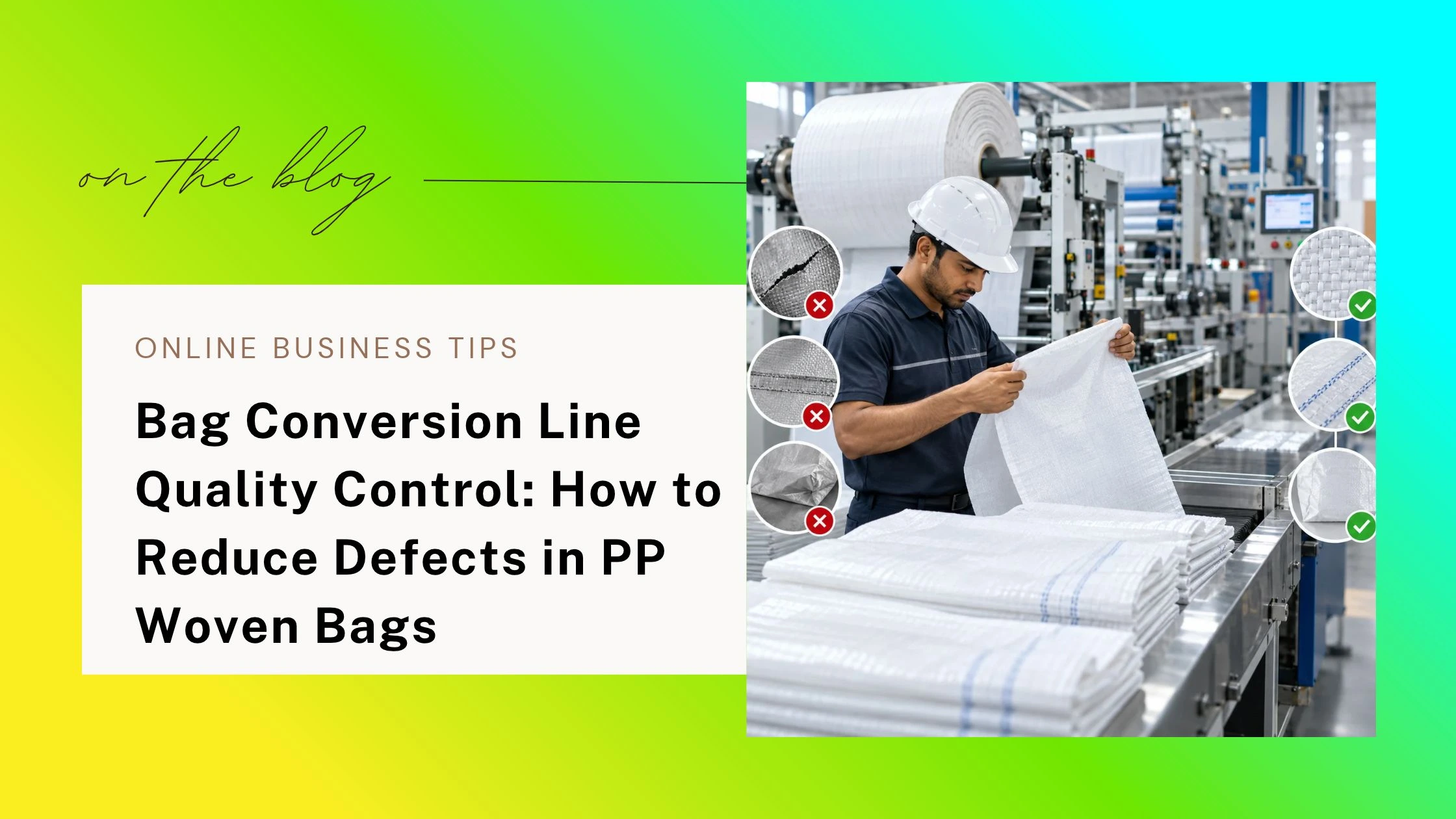
Quality consistency is one of the biggest challenges in PP woven bag manufacturing. A bag may look acceptable at first glance, yet small variations in cutting, folding, stitching, dimensions, alignment, or finishing can create problems during filling, stacking, transportation, and storage. This is why Bag Conversion Line Quality Control needs to be treated as a continuous production process rather than a final inspection performed after the bags are finished.
For manufacturers serving agriculture, food grains, fertilizers, chemicals, cement, animal feed, minerals, and other industrial packaging markets, controlling defects can directly influence material waste, production efficiency, customer complaints, and finished-bag performance. A structured quality system checks the process at multiple stages so that defects are detected close to their source.
A modern conversion line can automate operations such as feeding, cutting, folding, gusseting, stitching, and stacking. However, automation does not remove the need for inspection. Instead, it makes consistent machine setup, monitoring, preventive maintenance, and measurement even more important. Bag Conversion Line Quality Control therefore combines machine accuracy, operator checks, material control, dimensional inspection, stitching inspection, and final product verification.
What Is Bag Conversion Line Quality Control?
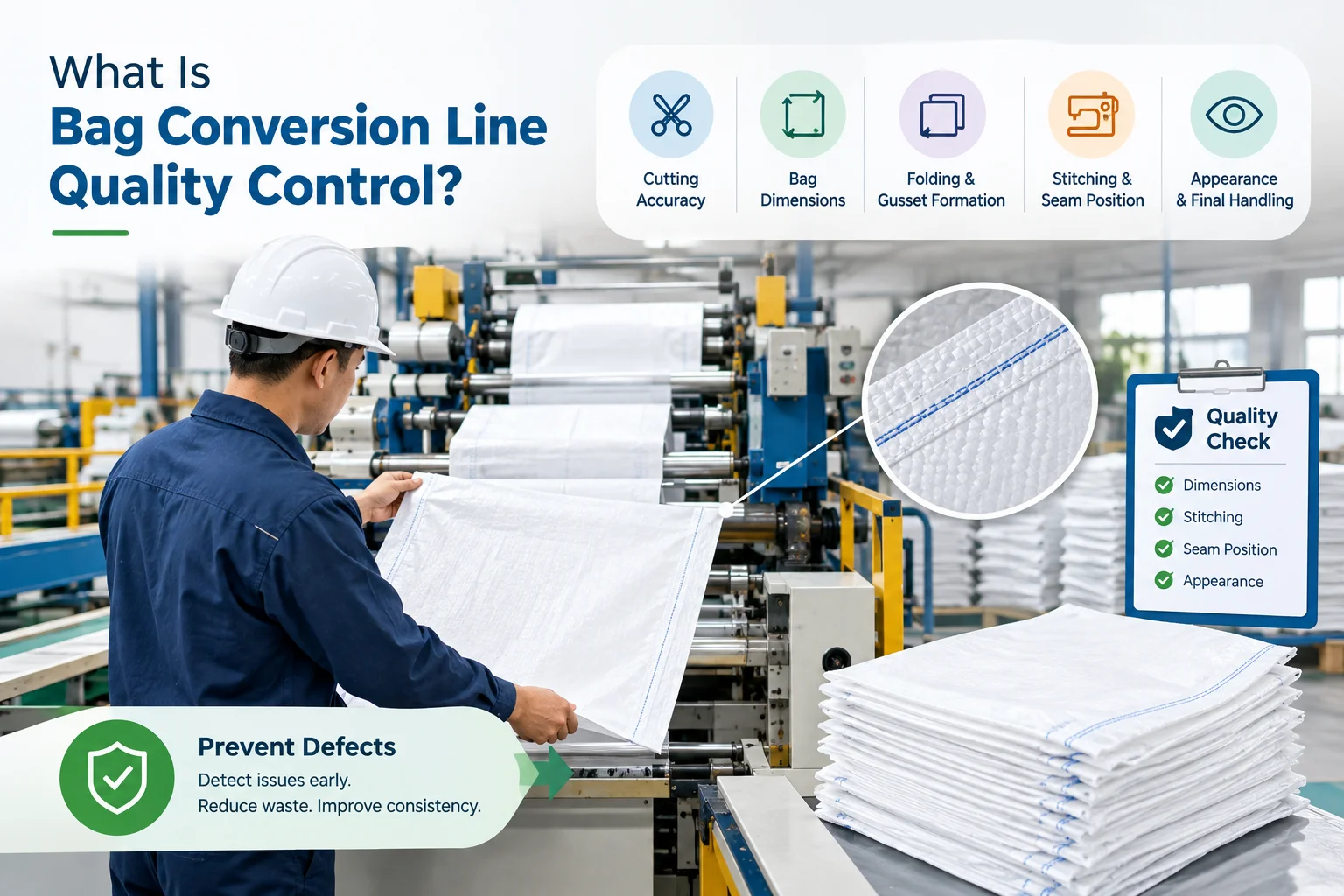
Bag Conversion Line Quality Control is the systematic inspection and control of the processes used to convert PP woven fabric into finished bags. It covers the characteristics that influence finished-bag consistency, including cutting accuracy, bag dimensions, folding, gusset formation where applicable, stitching, seam position, appearance, and final handling.
The objective is not simply to identify defective bags. Effective quality control attempts to prevent defects from being produced repeatedly. If a cutting problem is discovered only during final inspection, hundreds or thousands of bags may already require rework or rejection. If the cutting station is monitored continuously, the problem can be identified earlier and corrected before production losses increase.
This approach is consistent with the broader principle of controlling quality throughout production. BIS inspection guidance for HDPE/PP woven sacks includes visual and dimensional inspection alongside testing and documentation, while BIS schemes also recommend statistical quality-control approaches for relevant sack production.
Why Quality Control Matters in PP Woven Bag Production
PP woven bags are often manufactured in high volumes, meaning a small process variation can multiply quickly. A minor dimensional error repeated across a long production run can result in a large quantity of bags outside the customer's specification.
Good Bag Conversion Line Quality Control helps manufacturers control five interconnected areas:
-
Dimensional consistency: Length, width, gusset dimensions, fold positions, and other customer-specified measurements need to remain within the agreed specification.
-
Cutting accuracy: Clean and repeatable cutting reduces dimensional variation and material waste.
-
Stitching quality: Consistent stitch formation and seam positioning help create dependable closures.
-
Appearance and finishing: Wrinkles, loose threads, poor folds, contamination, and other visible defects can affect product acceptance.
-
Process stability: Consistent machine settings, maintenance, and inspection reduce recurring production variation.
The applicable specification depends on the bag's intended application. For example, BIS maintains separate standards for HDPE/PP woven sacks used for food grains and sugar, while ISO 23560 addresses woven polypropylene sacks for bulk foodstuff packaging.
Where Do PP Woven Bag Defects Usually Start?
Not every finished-bag defect originates at the conversion machine. The incoming woven fabric, printing condition, material characteristics, machine setup, tooling condition, and operator adjustments can all influence the final product.
For example, fabric width variation can create downstream dimensional problems. Incorrect feeding alignment can affect cutting position. A worn cutting component can contribute to inconsistent edges. Incorrect sewing settings can produce loose or irregular stitches.
Research into woven-bag production has also identified cutting, stitching, knitting/weaving, and printing among recurring defect categories, demonstrating why quality should be monitored across the production process rather than concentrated exclusively at the final inspection stage.
Key Inspection Points in a Bag Conversion Line
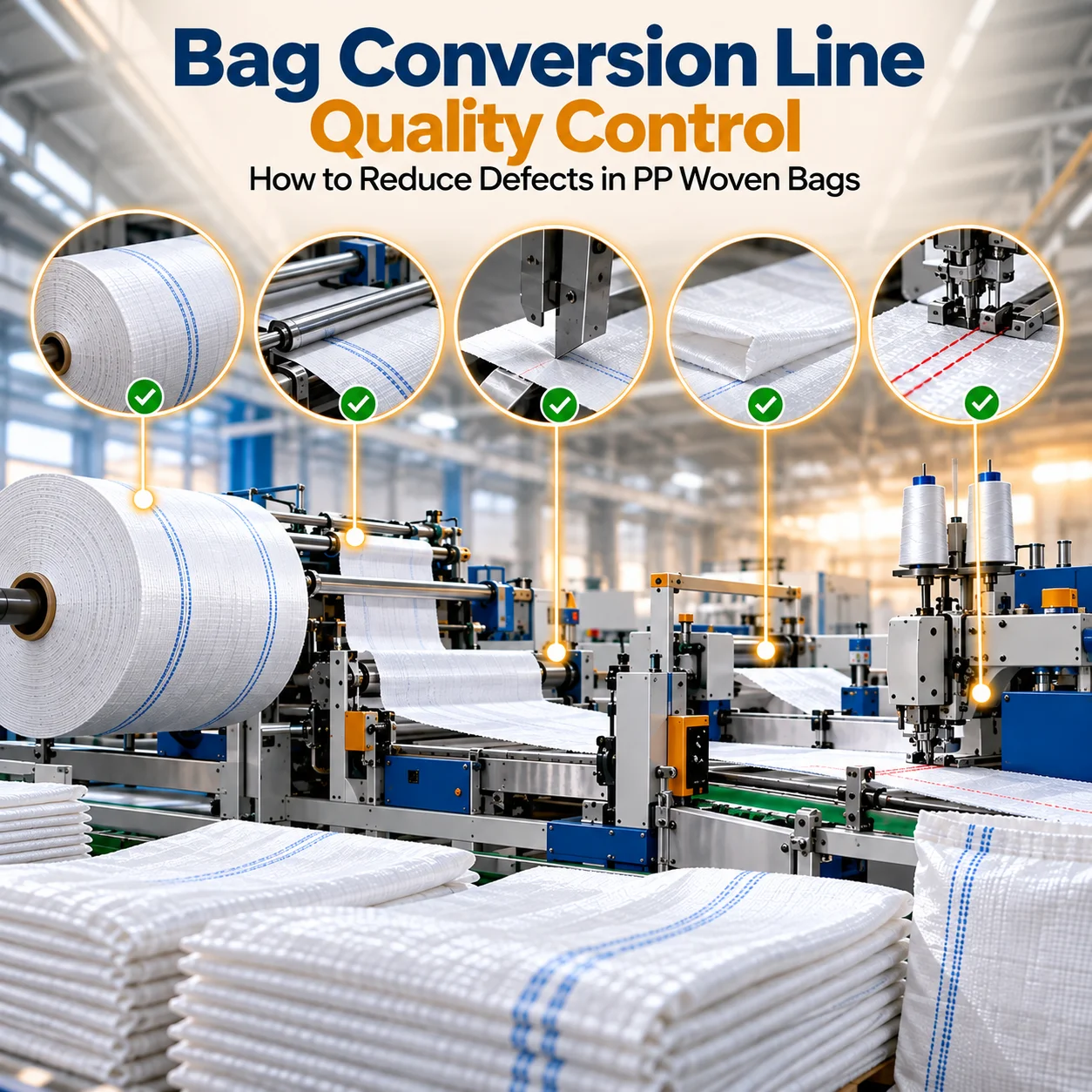
A practical Bag Conversion Line Quality Control system should establish defined inspection points rather than relying on occasional visual checks.
1. Incoming Fabric Inspection
Before conversion begins, verify the condition of the woven fabric against the customer's specification and production requirements. Important checks may include fabric width, appearance, roll condition, contamination, damage, printing alignment where applicable, and other agreed characteristics.
The purpose is to prevent unsuitable material from entering a high-speed conversion process.
2. Feeding and Alignment Inspection
Material must enter the conversion system consistently. Feeding or alignment problems can affect cutting position, folding, gusseting, printing alignment, and subsequent stitching.
Operators should watch for lateral movement, material tracking problems, wrinkles, and abnormal tension. Repeated deviations should be investigated rather than corrected manually throughout the entire production run.
3. Cutting Inspection
Bag Conversion Line Quality Control should give particular attention to cutting because cutting accuracy determines the basic dimensions of the finished bag.
Checks should compare the produced bag against the approved specification. Measurement frequency should be determined by production conditions, customer requirements, process capability, and the manufacturer's quality system rather than using one universal inspection interval.
Cutting tools should also be inspected for wear, contamination, damage, or alignment issues. A recurring uneven-cutting defect can sometimes be related to tooling condition or incorrect machine setup.
4. Folding and Gusset Inspection
Where the bag design requires folding or gusseting, the fold position and symmetry should remain consistent. Uneven folds can influence bag appearance, filling behaviour, stacking, and subsequent sewing.
The correct inspection criteria depend on the finished-bag design. Manufacturers should therefore establish documented reference samples or approved specifications instead of relying only on visual judgement.
5. Stitching Inspection
PP woven bag quality control must include stitching because the seam is a critical functional part of many woven sacks.
Inspectors should look for skipped stitches, loose threads, inconsistent stitch density, poor seam alignment, excessive thread tension, incomplete seams, and stitching that is too close to or too far from the intended edge.
Specific requirements vary by sack type and applicable standard. ISO 23560, for example, specifies construction and bottom-seam requirements for certain woven PP sacks used for bulk foodstuff packaging, including stitch arrangement and seam dimensions.
Common Bag Conversion Line Defects and Their Causes
Understanding the relationship between a defect and its possible source makes troubleshooting more effective. The following framework can help production teams investigate recurring problems.
|
Defect observed |
Possible process causes |
Quality-control response |
|
Uneven bag length |
Cutting setup, material tracking, inconsistent feeding |
Check measurement, alignment and cutting settings |
|
Uneven bag width |
Fabric variation, alignment issue, cutting position |
Verify incoming fabric and machine alignment |
|
Frayed or irregular edge |
Cutting-tool condition or incorrect cutting setup |
Inspect tooling and cutting mechanism |
|
Loose stitching |
Thread tension, sewing setup, worn components |
Check thread path, tension and sewing settings |
|
Skipped stitches |
Needle/thread condition, machine timing or sewing adjustment |
Inspect sewing components and machine timing |
|
Misaligned seam |
Incorrect feeding, folding or sewing alignment |
Verify guides, folds and stitch position |
|
Uneven gusset |
Folding/gusseting adjustment or material tracking |
Check guides, rollers and machine setup |
|
Wrinkled bags |
Material handling, tension or folding conditions |
Inspect material path and machine settings |
|
Excessive rejects |
Multiple process variations or inconsistent inspection |
Review defect records and identify recurring causes |
This table is a troubleshooting framework rather than a universal diagnosis. The actual cause should be established through inspection of the specific machine, material, operating conditions, and production data.
How to Reduce PP Woven Bag Defects
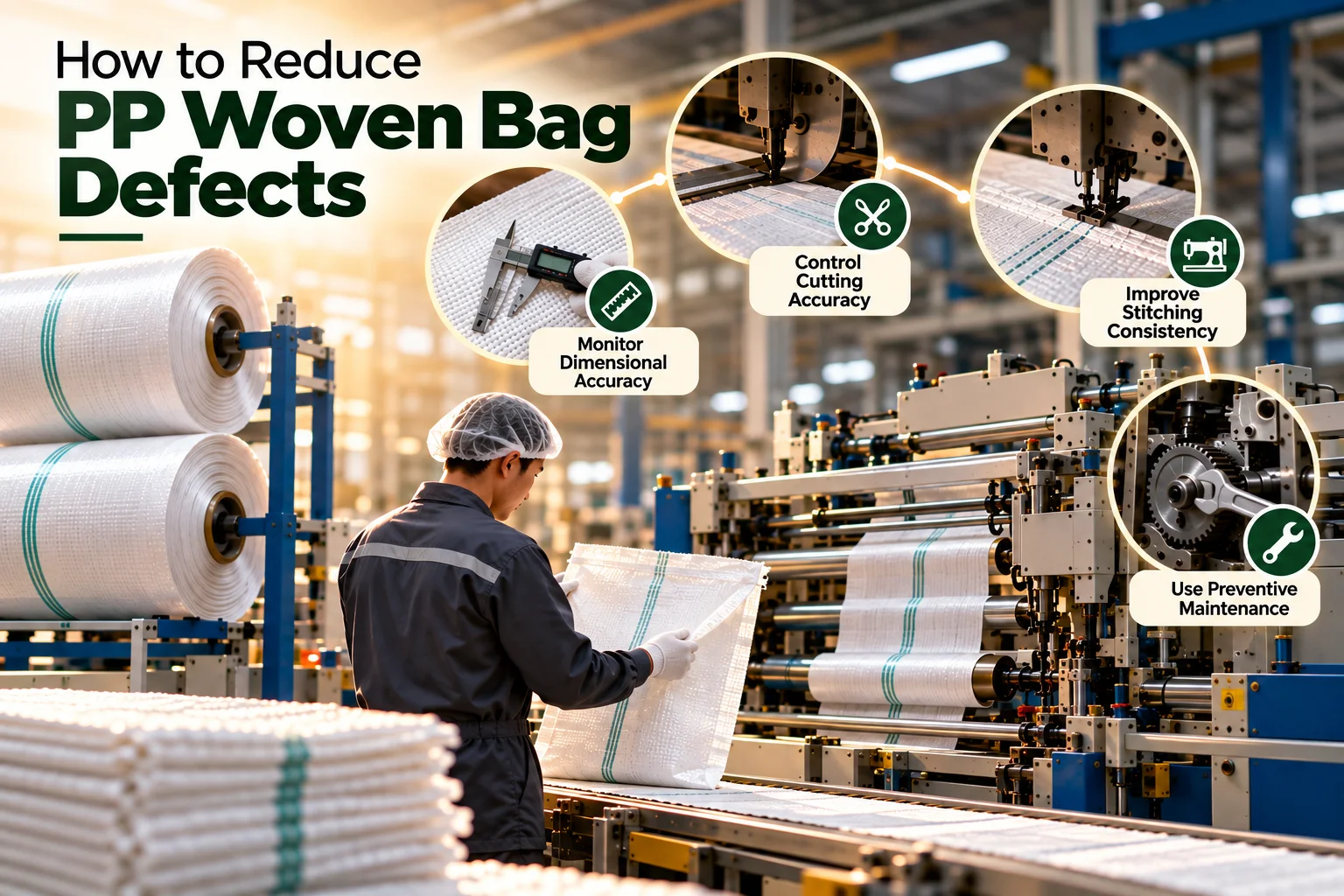
The most effective Bag Conversion Line Quality Control programmes combine prevention, measurement, and corrective action.
Standardise Machine Setup
Create documented setup procedures for each major bag specification. These can include approved dimensions, cutting settings, folding requirements, sewing parameters, material characteristics, and changeover checks.
Standardisation reduces dependence on individual operator memory and makes troubleshooting easier when production changes between bag sizes.
Monitor Dimensional Accuracy
PP woven bag dimensional accuracy should be measured against the approved product specification. Length and width are obvious checks, but other dimensions can matter depending on the bag design.
Measurements should be recorded rather than relying exclusively on visual inspection. A trend showing gradual dimensional movement can provide an early warning before bags fall outside the accepted specification.
Control Cutting Accuracy
Woven bag cutting accuracy directly affects the consistency of finished bags. Cutting should therefore be checked after setup, during production, and following significant adjustments or changeovers according to the plant's inspection plan.
If dimensions begin to drift, the team should determine whether the cause is machine alignment, material movement, tooling wear, or another process condition.
Improve Stitching Consistency
PP woven bag stitching quality depends on correct machine adjustment, appropriate thread, stable material feeding, and properly maintained sewing components.
Operators should inspect seams for visible defects and verify critical seam characteristics against the applicable product specification. Standards may define specific stitching requirements for particular applications, so manufacturers should use the relevant specification rather than assuming one stitch requirement applies to every PP woven sack.
Use Preventive Maintenance as Quality Control
Maintenance and quality are closely connected. Worn cutting components, poorly adjusted guides, damaged sewing components, contaminated surfaces, and mechanical misalignment can all contribute to defects.
For this reason, bag conversion machine quality control should work together with preventive maintenance. Maintenance records can also help identify components that repeatedly contribute to quality problems.
A Practical Bag Conversion Line Inspection Checklist
A bag conversion line inspection programme can be organised around a simple sequence:
-
Verify material and approved production specification before startup.
-
Check machine alignment, cutting settings, folding or gusseting setup, and sewing condition.
-
Measure initial bags after setup or changeover.
-
Record dimensional and visual inspection results during production.
-
Separate non-conforming bags so they cannot accidentally enter finished-goods stock.
-
Investigate recurring defects and record corrective actions.
-
Recheck production after adjustments before returning to normal output.
The exact frequency of each check should be established according to the manufacturer's quality system, product specification, process capability, customer requirements, and applicable standards.
What Should Finished Woven Bag Inspection Include?
Finished woven bag inspection should confirm that the completed bags meet the approved requirements before packing or shipment.
Typical areas include appearance, dimensions, cutting quality, fold or gusset condition, seam position, stitching condition, cleanliness, printing where applicable, and packaging quantity. Additional performance testing may be required depending on the bag's intended use and governing specification.
For regulated or specification-driven applications, manufacturers should maintain appropriate inspection records. BIS documentation for HDPE/PP woven sacks includes requirements around testing, inspection, records, sampling, and applicable product characteristics.
PP woven sack quality standards should therefore be treated as product-specific requirements rather than a single universal checklist. Food-grain, sugar, fertilizer, polymer, cement, and other industrial sacks may have different specifications.
How Data Helps With Bag Conversion Line Troubleshooting
Effective bag conversion line troubleshooting becomes easier when production teams record defects consistently.
Instead of recording only “bad bag,” classify the defect. For example, record whether it involves dimensions, cutting, stitching, folding, printing, appearance, contamination, or another category. Then track the frequency and timing.
This creates useful production information. If dimensional defects increase immediately after a changeover, setup should be investigated. If stitching problems gradually increase over several production runs, component wear or machine condition may deserve attention.
Statistical quality-control methods can be useful for identifying trends rather than reacting to individual defective bags. BIS testing and inspection guidance specifically recommends statistical quality-control approaches for relevant woven-sack production schemes.
How the Right Conversion Line Supports Quality
Machinery cannot replace a quality-management system, but a properly configured line can support process consistency.
Oberon Industries describes its conversion systems as automating processes such as cutting, folding, gusseting, valve insertion, stitching, and stacking, with an emphasis on consistent production and precision.
When evaluating equipment, manufacturers should look beyond headline production speed. Important questions include how the machine handles the required fabric, how accurately it performs the required operations, how easily settings can be adjusted, how changeovers are managed, what inspection and monitoring capabilities are available, and how maintenance and technical support are handled.
A quality-focused machine evaluation should therefore consider both productivity and process stability.
Building a Better Quality-Control System
A mature Bag Conversion Line Quality Control programme should connect machine setup, inspection, maintenance, documentation, and corrective action.
The workflow can be viewed as:
Specification → Setup → First-piece inspection → Process monitoring → Defect recording → Corrective action → Verification → Final inspection
The important principle is feedback. If an inspection identifies a defect, the information should return to the process that created it. This prevents final inspection from becoming the only quality-control barrier.
For international PP woven bag manufacturers, documentation is particularly useful when different operators, shifts, factories, or production batches need to maintain the same product requirements. Clear specifications and inspection records create a common reference point.
Conclusion
Effective Bag Conversion Line Quality Control is built around prevention rather than simply rejecting defective bags at the end of production. Dimensional checks, cutting inspection, stitching control, material verification, machine maintenance, process monitoring, and documented corrective actions work together to reduce variation and improve finished-bag consistency. The applicable inspection criteria should always be matched to the bag's intended application and relevant customer or industry specification.
For manufacturers planning to improve production consistency, equipment configuration is one part of the larger quality strategy. Oberon Industries provides bag conversion and industrial bag machinery solutions for manufacturers working with PP woven and related packaging formats. If you are evaluating a new line or upgrading an existing production process, discuss your bag dimensions, material, production requirements, and quality objectives with the technical team before selecting the appropriate configuration.
Frequently Asked Questions
1. What is Bag Conversion Line Quality Control?
Bag Conversion Line Quality Control is the systematic monitoring of material handling, cutting, folding, gusseting, stitching, dimensions, appearance, and finished-bag requirements during the conversion process. Its purpose is to reduce variation and identify defects before they become large production problems.
2. What are the most common PP woven bag defects?
Common PP woven bag defects can include dimensional variation, uneven cutting, poor folding, gusset irregularities, loose or skipped stitching, seam misalignment, wrinkles, printing problems, and other appearance or finishing issues. The exact defect profile depends on the production process and bag design.
3. How can manufacturers improve PP woven bag production quality?
Manufacturers can improve PP woven bag production quality by standardising machine setup, checking incoming material, monitoring dimensions, controlling cutting and stitching, maintaining equipment, recording defects, and using corrective-action procedures.
4. How often should PP woven bags be inspected?
There is no single inspection frequency that applies to every product. The inspection plan should consider the bag specification, production process, customer requirements, applicable standards, historical defect rates, and process stability. Higher-risk or less stable processes may require more frequent checks.
5. What causes dimensional problems in converted PP woven bags?
Dimensional problems can result from incorrect machine settings, fabric variation, material tracking, alignment problems, cutting-tool condition, or changeover errors. PP woven bag dimensional accuracy should be monitored against the approved specification so that process drift can be detected early.
6. Can a bag conversion line eliminate defects completely?
No machine can guarantee zero defects. A well-designed conversion system can support consistent cutting, folding, stitching, and handling, but final quality also depends on material condition, machine setup, maintenance, operator practices, inspection, and the applicable product specification.


