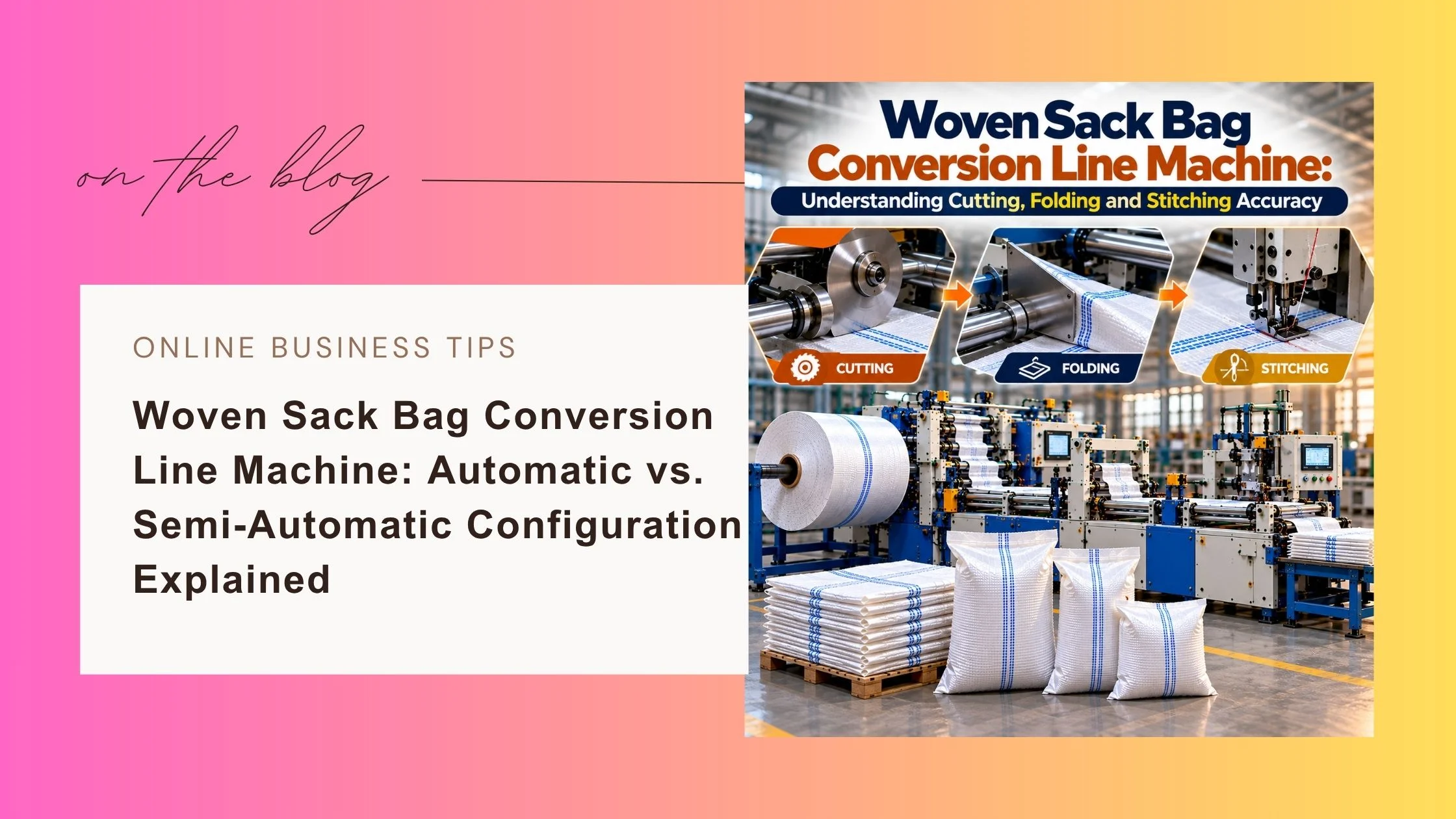
Woven Sack Bag Conversion Line Machine: Cutting Accuracy

September 02, 2026
Introduction
Buying an automated bag-making system is not simply a question of machine price. For manufacturers, the real question is much more interesting: how quickly will the investment pay for itself? That is where Bag Conversion Line ROI becomes a practical financial tool rather than a shiny number on a quotation. A conversion line can influence output, labour requirements, material efficiency, downtime and production consistency, so every one of those factors deserves a place in your calculation.
If you already manufacture PP woven bags or plan to expand production, understanding Bag Conversion Line ROI can help you compare automation with conventional production methods. Instead of looking only at the upfront bag conversion line cost, you can evaluate the complete investment over its working life. Explore your bag conversion line solutions to understand how machine configuration can influence production economics.
For a manufacturer, this approach changes the conversation. You are no longer asking, “How much does this machine cost?” You are asking, “How much does each bag cost after automation, how much labour can I save, and how many months will it take to recover my investment?” That is a much better question.
What Does Bag Conversion Line ROI Actually Mean?
Bag Conversion Line ROI measures the financial return generated by investing in a bag conversion line compared with the money you put into the equipment and its supporting infrastructure. In simple terms, it helps you determine whether increased production capacity, lower operating costs and labour savings justify the initial capital expenditure.
A useful ROI calculation should include more than machine purchase price. Installation, electrical work, operator training, spare parts, tooling, maintenance and commissioning can all affect the actual bag conversion line investment. On the benefit side, you should consider production volume, selling margin, reduced labour costs, lower waste and improved utilisation.
The basic ROI formula is straightforward:
ROI (%) = Annual net financial benefit ÷ Total investment × 100
However, ROI alone does not tell you how quickly you recover the money. That is why manufacturers should also calculate the bag conversion line payback period.
Payback period = Total investment ÷ Annual cash benefit
These two numbers work well together. ROI tells you how attractive the investment may be over a defined period, while payback tells you how long you must wait before the original investment has effectively been recovered.
Start With Your Current PP Woven Bag Production Cost
Before estimating savings, I recommend establishing your current PP woven bag production cost as accurately as possible. Otherwise, you may build a beautiful spreadsheet around assumptions that have very little connection with the factory floor.
Your baseline should include direct labour, electricity, material consumption, machine running costs, maintenance, rejected bags, rework and other production expenses. If your existing process requires several manual handling stages, record the labour hours involved rather than simply writing down the monthly wage bill.
For example, imagine a plant producing 100,000 bags per month. If production requires several operators for cutting, folding, sewing and finishing, the labour component can become significant as volumes rise. Automation may not eliminate every employee, but it can reduce manual intervention and allow the same workforce to manage greater output.
This baseline becomes the reference point for calculating your automated bag production ROI. Think of it as taking a photograph of your current factory before giving the production line a makeover.
How Bag Conversion Line Cost Affects the Investment

The purchase price is obviously important, but two machines with similar headline prices can produce very different financial results. A basic line may have a lower entry cost, while a higher-capacity automated system may require more capital but deliver greater output and lower labour requirements.
Your bag conversion line cost can include the main equipment, auxiliary units, electrical installation, commissioning, transportation, tooling and initial spare parts. If you overlook these items, your payback calculation can look far better on paper than it does in reality.
Production requirements should therefore drive equipment selection. If your factory needs multiple bag sizes, frequent format changes or high-volume output, machine flexibility can have a direct impact on profitability. Paying slightly more for useful automation may make sense if it reduces setup time or increases productive hours.
When comparing suppliers, ask for a complete specification rather than comparing one machine price against another. A lower quotation does not automatically represent a lower total cost of ownership.
Calculate the Real Labour Cost Savings
Labour cost savings often form a major part of an automation business case. But you should calculate them carefully. Replacing five operators with two does not necessarily mean that the full wages of three employees become immediate savings.
You may redeploy staff to other production activities, quality control, packing or logistics. In that situation, the financial benefit comes from increasing production capacity without adding equivalent headcount. That can be even more valuable than simply reducing payroll.
Consider a factory where an existing process needs six operators to maintain a particular output. An automated line might reduce the direct operating requirement while also improving material handling and production consistency. If demand grows, the business can potentially increase output without increasing labour at the same rate.
For a realistic Bag Conversion Line ROI calculation, measure labour savings against actual production volume. Then consider whether the saved labour creates direct cash savings, additional production capacity or both.
Production Volume Can Change the Entire ROI Calculation
A machine rarely creates attractive returns simply because it is technologically advanced. It creates returns when you use its capacity effectively.
Suppose your conversion line can produce significantly more bags than your current setup, but your factory only has enough orders to keep it running for a few hours each day. Your theoretical capacity means very little financially. On the other hand, a plant with strong demand and limited existing capacity may recover its bag conversion line investment much faster.
This is why production planning should sit beside the financial calculation. Look at your current orders, expected growth, seasonal demand and available operating hours. Then estimate realistic utilisation rather than using the machine's maximum output as your everyday production figure.
A sensible business case often uses three scenarios: conservative, expected and high utilisation. This gives you a more honest picture of potential bag conversion line profitability.
Bag Production Cost Per Bag: The Number Buyers Really Understand
One of the easiest ways to understand automation is to calculate the production cost per bag before and after investment. This converts complicated factory economics into a number that managers, buyers and finance teams can understand immediately.
For example, if your existing process costs $0.12 per bag and automation reduces the cost to $0.105, the saving is $0.015 per bag. At 1 million bags, that difference becomes $15,000. At 10 million bags, it becomes $150,000.
The actual figures will vary according to materials, labour rates, electricity, production speed, bag specifications and local operating conditions. Still, the principle remains powerful: a small saving multiplied across millions of bags can create a substantial annual benefit.
Operating Costs Matter After the Machine Is Installed
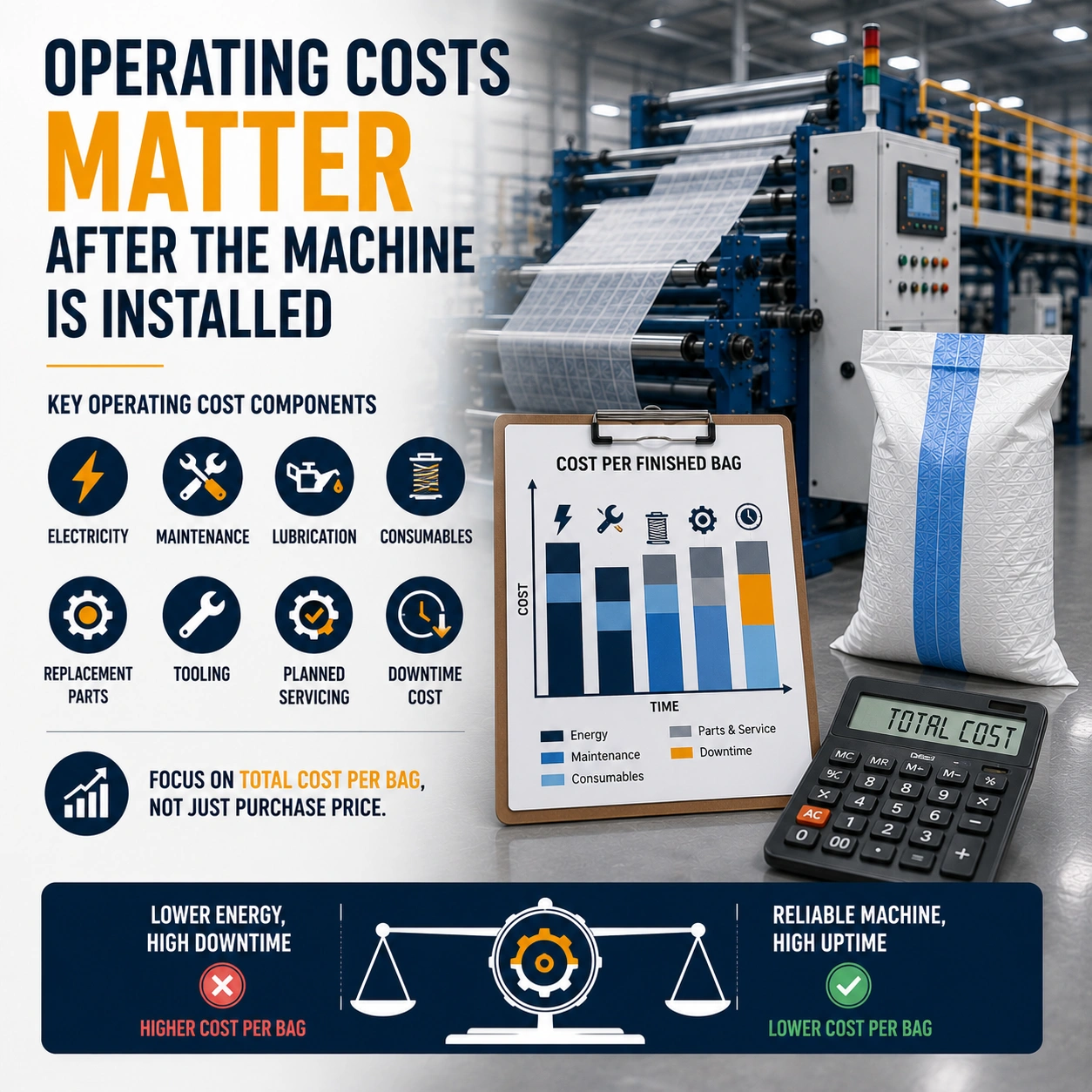
A common mistake in ROI calculations is treating the machine purchase as the end of the financial story. It is actually the beginning.
Your bag conversion machine operating cost may include electricity, routine maintenance, lubrication, consumables, replacement parts, tooling and planned servicing. Downtime also has an economic cost because an idle production line can prevent you from producing saleable bags.
Energy efficiency can matter, but so can machine reliability. A line that consumes slightly less electricity but experiences frequent stoppages may produce a worse financial result than a robust system that maintains consistent production.
That is why I would always compare expected output, uptime, maintenance requirements and service support alongside energy consumption. The cheapest machine to run is not necessarily the machine that delivers the lowest cost per finished bag.
A Simple Bag Conversion Line ROI Calculation
Here is a practical example. Imagine a manufacturer invests $300,000 in a complete conversion system, including installation and commissioning. After stabilising production, the company generates $100,000 in annual labour and operating savings.
Using the simplified payback formula:
$300,000 ÷ $100,000 = 3 years
The estimated payback period would therefore be three years.
If the same project generates $120,000 in annual net benefit, the payback falls to 2.5 years. If annual benefit reaches $150,000, the payback becomes two years.
|
Factor |
Example |
|
Total investment |
$300,000 |
|
Annual net benefit |
$100,000 |
|
Payback period |
3 years |
|
Annual net benefit at higher utilisation |
$150,000 |
|
Payback at higher utilisation |
2 years |
These figures are only an illustration. Your actual Bag Conversion Line ROI should use your machine quotation, production capacity, labour rates, operating schedule, material costs and expected sales margin.
How Automation Can Improve Bag Conversion Line Profitability
Automation can influence profitability in several ways at once. Faster production may increase available capacity, while consistent cutting and finishing can reduce rework. Lower manual handling can reduce labour intensity, and better process control may help manufacturers maintain consistent bag dimensions.
However, I would avoid assuming that every efficiency automatically becomes profit. If the market will not absorb additional production, higher output may simply increase inventory. Similarly, reducing labour without maintaining quality can create expensive customer complaints.
The strongest business case connects machine performance with commercial demand. If you can sell the additional bags at a healthy margin, automation becomes much more attractive.
Bag Conversion Machine ROI vs Manual Production
Manual or semi-automatic production can make sense for small operations, particularly when volumes remain unpredictable. The initial capital requirement is generally lower, and operators can sometimes switch between tasks easily.
Automated production becomes increasingly attractive as volume, consistency and labour costs rise. The machine requires more upfront capital, but it can deliver greater output with a more controlled production process.
The decision is therefore not simply “manual versus automatic”. It is about matching production technology to your order book, workforce, product range and growth plans. A small business with low utilisation may prioritise flexibility, while a high-volume manufacturer may prioritise throughput and repeatability.
What Production Data Should You Track?

Good Bag Conversion Line ROI analysis continues after installation. Once the equipment starts operating, actual production data can reveal whether your original assumptions were realistic.
During the first few months, monitor output, downtime, reject rates, labour hours, electricity consumption and maintenance costs. Compare those numbers against your original business case.
Useful measurements include:
-
Bags produced per shift
-
Production cost per bag
-
Labour hours per 1,000 bags
-
Material waste and rejected bags
-
Planned versus unplanned downtime
-
Maintenance expenditure
-
Monthly machine utilisation
This information helps you identify where the investment performs well and where improvements can increase returns.
Why Machine Configuration Influences Payback
Not every bag conversion line suits every manufacturer. Bag size, fabric type, printing requirements, cutting method, folding configuration and sewing requirements can all influence equipment selection.
If your factory produces several product formats, changeover efficiency becomes especially important. A machine that performs beautifully on one product but requires lengthy setup for another may reduce practical utilisation.
This is where an experienced manufacturer such as Oberon Industries can help you evaluate the relationship between machine configuration, production requirements and investment expectations rather than treating equipment selection as a simple price comparison.
How to Build a More Reliable Investment Forecast
A strong investment forecast should avoid overly optimistic assumptions. Start with realistic production hours, not maximum theoretical machine speed. Use conservative sales forecasts and include maintenance, training and other ownership costs.
I also recommend creating three financial scenarios. The conservative case assumes lower utilisation or slower market growth. The expected case reflects your most realistic production plan. The stronger case assumes higher utilisation and favourable demand.
This approach makes Bag Conversion Line ROI more useful for management decisions because it shows how sensitive the project is to production volume and operating performance.
When Does a Bag Conversion Line Investment Make Sense?
A conversion line tends to make stronger financial sense when you already have consistent demand, sufficient operating hours, high labour involvement and a clear need for increased capacity. It can also become attractive when inconsistent manual production creates quality issues or expensive rework.
The opposite can also be true. If orders fluctuate heavily, production volumes remain low or the business lacks sufficient working capital, a large investment may create unnecessary financial pressure.
The right answer depends on your numbers. A machine should earn its place on the factory floor.
Conclusion
A successful Bag Conversion Line ROI calculation starts with real production data, not optimistic assumptions. You need to consider the complete investment, PP woven bag production cost, labour requirements, operating expenses, production volume, downtime and expected contribution margin. When those figures work together, you can estimate bag production cost per bag, labour cost savings, payback period and long-term profitability with far greater confidence.
If you are considering automation, now is the time to turn the numbers into a practical production plan. Review your current costs, identify where automation could create measurable savings and compare those savings against the complete investment. Speak with the team at Oberon Industries to discuss your requirements and explore suitable bag conversion line solutions for your production goals.
FAQs
1. How do I calculate Bag Conversion Line ROI?
Calculate your annual net financial benefit from labour savings, increased production contribution and operating efficiencies, then divide that benefit by the total investment and multiply by 100. Include installation and ownership costs for a more realistic result.
2. What is a typical bag conversion line payback period?
There is no universal payback period because production volume, labour costs, machine utilisation, product margins and investment size vary between manufacturers. A reliable calculation should use your own operating data rather than an industry-wide estimate.
3. Does automation always reduce PP woven bag production cost?
Not automatically. Automation can reduce labour intensity, waste and production time, but the final cost depends on machine utilisation, maintenance, energy consumption, material efficiency and production planning.
4. How can I improve automated bag production ROI?
You can improve returns by maintaining high machine utilisation, reducing unnecessary downtime, controlling material waste, training operators properly and matching production capacity with genuine market demand.
5. Should I focus on ROI or payback period?
Use both. Payback shows how quickly you recover the investment, while ROI helps you understand the financial return over a defined period. Looking at both provides a more complete picture of the investment.