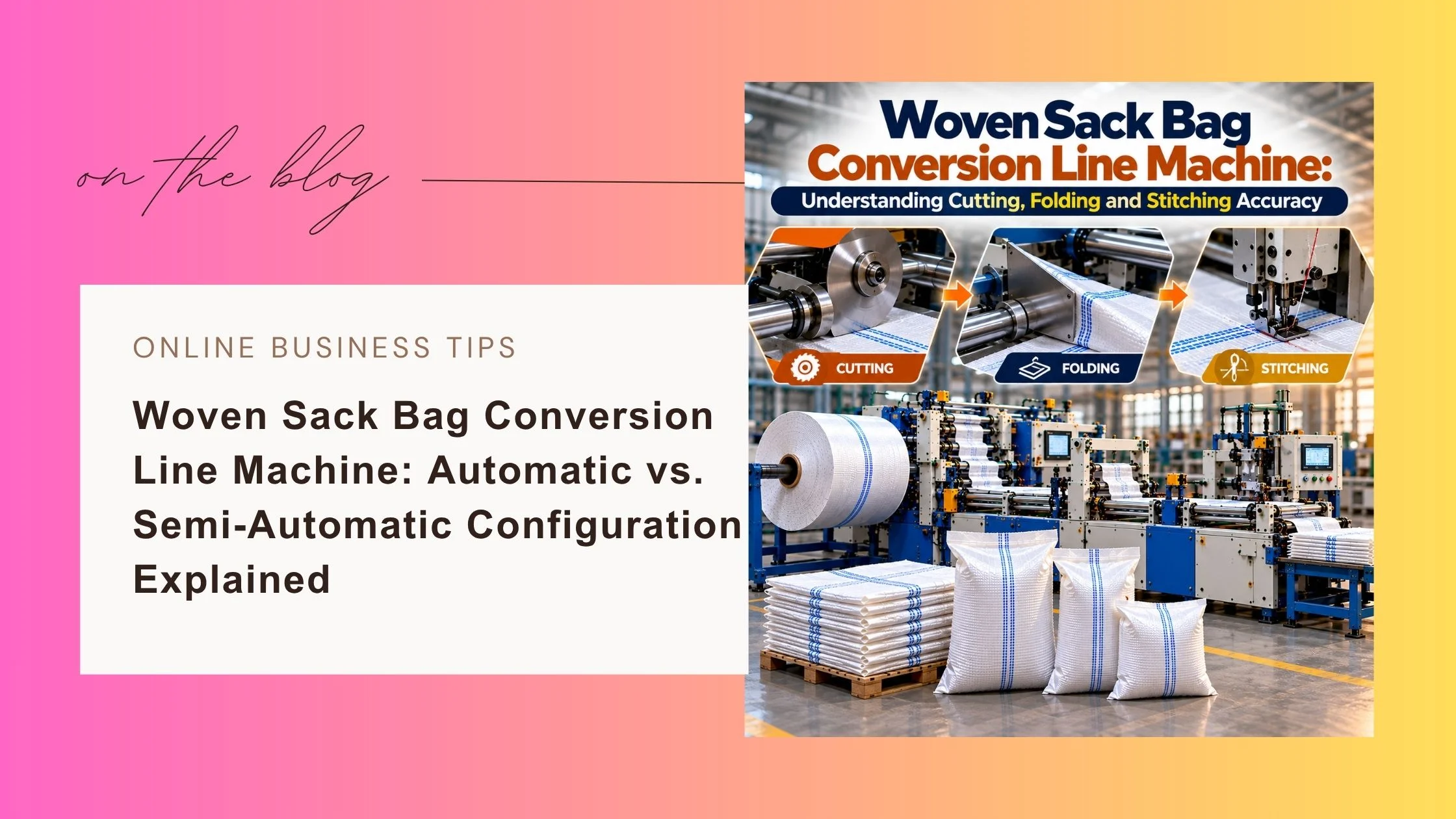
Woven Sack Bag Conversion Line Machine: Cutting Accuracy

September 03, 2026
A machine rated at 100 bags per minute may sound impressive on paper. But does that mean your factory will actually produce 6,000 saleable bags every hour? Not necessarily.
Understanding Bag Conversion Line Capacity requires looking beyond the headline machine speed. Real production depends on bag size, fabric characteristics, cutting length, stitching configuration, changeovers, operator performance, material feeding, downtime, quality requirements, and the machine utilization rate. For manufacturers planning a new facility or expanding an existing one, these factors determine whether the expected production target is realistic.
A properly planned bag conversion line can deliver consistent high-volume output when its configuration matches the required bag specifications and production schedule. The important question is therefore not simply "How fast can the machine run?" but "How many good-quality bags can the complete line reliably produce per hour?"
What Is Bag Conversion Line Capacity?
Bag Conversion Line Capacity refers to the amount of finished, saleable bags a complete conversion system can produce within a specific period, normally measured in bags per hour, bags per shift, or bags per day.
Manufacturers often describe equipment using a rated production speed. However, rated speed represents a machine's operating capability under specified conditions. Actual bag conversion line production capacity can be lower because real factories experience material loading, adjustments, changeovers, maintenance, quality checks, and other interruptions.
For example, a machine theoretically producing 5,000 bags per hour may deliver 4,000 or 4,300 saleable bags per hour under normal operating conditions. That does not necessarily indicate poor performance. Instead, it reflects the difference between theoretical capacity and practical production output.
For purchasing decisions, practical output is usually more important than the maximum number shown in a machine specification.
Rated Speed vs Real Bag Production Output

The difference between rated speed and actual output is one of the most important concepts in Bag Conversion Line Capacity planning.
Suppose a line is rated at 80 bags per minute. The theoretical hourly output is:
80 × 60 = 4,800 bags per hour
That number assumes uninterrupted production at the rated speed. In reality, the line may stop for material changes, adjustments, maintenance, quality inspections, or other reasons.
If the machine operates at an effective utilization of 85%, the estimated practical output becomes:
4,800 × 85% = 4,080 bags per hour
This simplified calculation gives a much more useful planning figure. It also demonstrates why businesses should avoid building production forecasts entirely around maximum machine speed.
When comparing equipment, ask suppliers about expected output under your actual bag specifications. A production trial can provide more meaningful information than a theoretical rating.
How to Calculate Bag Conversion Line Production Capacity
The basic calculation is straightforward:
Hourly Production = Bags Per Minute × 60
For example, if a conversion line produces 70 bags per minute:
70 × 60 = 4,200 bags per hour
But this is theoretical output. To estimate actual production, introduce an efficiency or utilization factor:
Actual Output = Rated Output × Machine Utilization Rate
If the line has a theoretical capacity of 4,200 bags per hour and achieves 85% utilization:
4,200 × 0.85 = 3,570 bags per hour
Over an eight-hour shift, this becomes:
3,570 × 8 = 28,560 bags per shift
This is a better basis for production planning because it recognizes that industrial equipment rarely operates continuously at maximum rated speed.
What Determines Bag Conversion Line Capacity?
Several variables influence Bag Conversion Line Capacity, and the machine's nominal speed is only one of them.
Bag dimensions can have a major effect. A simple small-format bag may be processed faster than a larger or more complex construction because the machine must complete different cutting, folding, stitching, or handling movements.
Fabric properties also matter. Thickness, coating, stiffness, surface characteristics, and fabric consistency can affect feeding and processing stability. The machine may need different settings depending on the polypropylene woven fabric being converted.
Bag construction is another important factor. Bags with gussets, special stitching, multiple handles, liners, printing requirements, or other features may require additional processing steps and therefore change the achievable production rate.
Finally, changeovers matter. A factory producing one standard bag continuously may achieve much higher effective output than a plant frequently switching between different sizes and specifications.
Bag Conversion Line Output Per Hour: A Practical Example

Consider a hypothetical automatic line with a rated speed of 75 bags per minute.
The theoretical bag conversion line output per hour would be:
75 × 60 = 4,500 bags
Now assume the factory achieves an overall utilization rate of 80%.
4,500 × 0.80 = 3,600 bags per hour
If the line operates for two eight-hour shifts:
3,600 × 16 = 57,600 bags per day
Over 26 production days, the estimated monthly output becomes:
57,600 × 26 = 1,497,600 bags
This calculation is useful for capacity planning, but it remains an estimate. Actual bag production output can change with product mix, downtime, material availability, operator experience, maintenance requirements, and quality rejection.
A good production plan therefore uses conservative assumptions rather than the highest theoretical number.
Bag Making Machine Capacity and Product Specifications
Bag making machine capacity cannot be evaluated independently of the product being manufactured. A machine designed for one bag specification may deliver a different output when the product dimensions or construction change.
For example, changing bag length can affect cutting cycles. Increasing bag width may influence material handling. Adding a gusset or specialized stitching operation can also change the production sequence.
This means buyers should provide detailed product specifications when requesting capacity information. Useful information includes bag dimensions, fabric type, GSM or thickness, bag construction, stitching method, printing requirements, desired production volume, and expected shift pattern.
A supplier can then recommend a configuration based on the actual application rather than giving a generic capacity estimate.
PP Woven Bag Machine Production Capacity
PP woven bag machine production capacity is particularly important for manufacturers serving high-volume markets such as agriculture, fertilizer, chemicals, animal feed, construction materials, food packaging, and industrial products.
In these markets, production consistency often matters as much as maximum speed. Customers may require millions of bags per month, making small differences in effective output significant over a full production year.
For example, an additional 300 saleable bags per hour may appear modest. If a factory operates 16 hours per day for 26 days per month, that difference represents:
300 × 16 × 26 = 124,800 additional bags per month
That is why capacity should always be evaluated over the intended production schedule rather than only on an hourly basis.
A high-speed bag conversion line can become particularly valuable when the factory has stable demand and sufficient material supply to keep the equipment running productively.
Automatic Bag Conversion Line Speed vs Actual Efficiency
Automatic bag conversion line speed refers to how quickly the equipment can perform its conversion cycle under specified operating conditions. Efficiency, however, measures how effectively that available production time is converted into useful output.
A machine may be capable of running quickly but still have low overall productivity if operators frequently stop the line, material feeding is inconsistent, or changeovers take too long.
This is why Bag Conversion Line Capacity should be assessed alongside bag conversion line efficiency. A slightly slower line with excellent uptime can produce more bags per month than a faster machine with frequent stoppages.
For example:
|
Scenario |
Rated Speed |
Utilization |
Effective Output |
|
Line A |
5,000 bags/hour |
70% |
3,500 bags/hour |
|
Line B |
4,500 bags/hour |
90% |
4,050 bags/hour |
|
Line C |
5,500 bags/hour |
75% |
4,125 bags/hour |
This simple comparison shows why the fastest machine is not automatically the most productive choice.
Understanding the Machine Utilization Rate
The machine utilization rate represents the proportion of available production time during which equipment is actually producing according to the relevant production standard.
A simplified calculation is:
Machine Utilization Rate = Productive Production Time ÷ Available Production Time × 100
If a machine is scheduled for 10 hours but spends one hour in planned and unplanned stoppages, productive time is approximately nine hours.
9 ÷ 10 × 100 = 90% utilization
However, factories should define utilization consistently. Some calculations consider only operating time, while more comprehensive production measurements may incorporate speed losses and quality losses as well.
For deeper manufacturing analysis, businesses can also examine Overall Equipment Effectiveness (OEE), which considers availability, performance, and quality. The U.S. Department of Energy provides broader guidance on improving manufacturing efficiency and energy performance.
How Changeovers Affect Bag Conversion Line Capacity
Changeovers are often overlooked when manufacturers estimate annual production. Yet frequent product changes can significantly reduce available production time.
Imagine a factory producing five different bag sizes. Each changeover requires cleaning, adjustment, parameter changes, trial production, and quality approval. If each changeover consumes 20 minutes and the factory performs ten changeovers per day, more than three hours of production time could be lost.
A factory with a smaller product range may achieve a higher effective Bag Conversion Line Capacity because the equipment spends more time producing and less time being adjusted.
This does not mean manufacturers should avoid product variety. Instead, production schedules should group similar bag specifications where practical and reduce unnecessary changeovers.
How to Plan Bags Per Hour Production for Your Factory
Start capacity planning with customer demand rather than machine speed. Determine how many finished bags you need to manufacture per month and work backward to establish the required hourly output.
For example, suppose your business needs to produce 2 million saleable bags each month. If you operate 26 days per month with two eight-hour shifts, you have:
26 × 16 = 416 production hours per month
The required average output is therefore:
2,000,000 ÷ 416 ≈ 4,808 bags per hour
If you expect an 85% utilization rate, the required rated capacity would be approximately:
4,808 ÷ 0.85 ≈ 5,656 bags per hour
This approach is much more useful than simply selecting a machine advertised at 5,000 or 6,000 bags per hour. It connects your production requirement with realistic operating conditions.
High Speed Bag Conversion Line: When Does It Make Sense?
A high speed bag conversion line makes the most sense when demand is strong enough to keep the equipment consistently utilized.
If a factory has confirmed orders for several million bags per month, additional capacity can help reduce production bottlenecks and support business growth. A high-speed system may also make sense when labor availability is limited and automation can improve production consistency.
However, higher speed comes with other considerations. Material supply, quality control, downstream packaging, storage space, electrical infrastructure, maintenance capability, and operator training must all support the intended output.
There is little financial advantage in buying a machine capable of producing 6,000 bags per hour if the rest of the factory can only supply or pack 3,500 bags per hour.
Capacity should therefore be considered as a complete production system rather than an isolated machine specification.
How to Improve Bag Conversion Line Efficiency

Improving Bag Conversion Line Capacity does not always require purchasing faster machinery. Existing equipment can often deliver more saleable output when production losses are systematically reduced.
Useful areas for improvement include:
-
Reducing unnecessary changeover time
-
Improving preventive maintenance
-
Training operators on standard operating procedures
-
Maintaining consistent material quality
-
Monitoring downtime causes
-
Reducing rejected bags
-
Optimizing production scheduling
The most valuable improvement will depend on where the factory currently loses time or output. If downtime is the biggest problem, maintenance improvements may produce a stronger result than increasing machine speed. If quality rejection is high, process control may provide the better return.
Why Saleable Output Matters More Than Theoretical Capacity
A machine's theoretical output does not necessarily equal its commercial production output.
Suppose two machines both have a nominal capacity of 5,000 bags per hour. Machine A produces 4,300 saleable bags per hour after downtime and quality losses. Machine B produces 4,700 saleable bags per hour.
Although both machines have the same rated speed, Machine B generates 400 additional saleable bags every hour.
Over 400 production hours, that difference becomes:
400 × 400 = 160,000 additional saleable bags
This is why manufacturers should ask suppliers to discuss expected saleable output under real production conditions. The number of bags that can actually be shipped to customers is the figure that matters commercially.
Capacity Planning Should Include Future Growth
When purchasing machinery, it is tempting to size the line exactly around today's demand. But industrial equipment can remain in service for many years, so future requirements should also influence the decision.
If current demand is 3 million bags per month and management expects demand to reach 4 million within several years, a machine operating close to maximum capacity today may become a bottleneck tomorrow.
At the same time, excessive overcapacity increases capital expenditure and can reduce the financial return on the investment. The best approach is to consider current demand, expected growth, shift patterns, product mix, and the possibility of adding additional equipment later.
A modular production strategy can sometimes provide a better balance between immediate investment and future scalability.
How to Validate Bag Conversion Line Capacity Before Purchase
The strongest capacity estimate comes from combining supplier specifications with your own production requirements.
Ask for a technical evaluation based on your actual fabric and bag dimensions. Where possible, arrange a production trial using representative material. Measure production speed, changeover time, downtime, rejection, operator requirements, and the quality of finished bags.
You should also confirm whether the stated capacity applies to a specific bag size or represents a broader operating range. Ask how different bag constructions affect speed and whether additional equipment or auxiliary systems are required to achieve the quoted output.
This approach helps turn a marketing specification into a realistic production forecast.
Conclusion
Bag Conversion Line Capacity is not simply the maximum speed written in a machine specification. Real production depends on bag design, material characteristics, machine configuration, changeovers, downtime, operator performance, quality losses, and the overall machine utilization rate. By calculating theoretical output first and then applying realistic utilization assumptions, manufacturers can estimate bags per hour production, shift output, monthly capacity, and future production requirements with much greater confidence.
If you are planning a new production line, expanding capacity, or replacing existing bag-making equipment, the best next step is to evaluate the machine against your actual bag specifications and target output. Oberon Industries can help you explore a suitable bag conversion solution and request a configuration or quotation based on your production requirements. A properly matched line can give your factory the capacity, consistency, and scalability needed to meet today's orders while preparing for future growth.
Frequently Asked Questions
1. What is Bag Conversion Line Capacity?
Bag Conversion Line Capacity is the quantity of finished bags a conversion line can produce during a specified period, such as an hour, shift, day, or month. Practical capacity should account for machine speed, utilization, downtime, changeovers, material conditions, and quality losses.
2. How many bags per hour can a bag conversion line produce?
The number varies significantly according to machine configuration, bag dimensions, fabric properties, construction, and operating conditions. To calculate a practical figure, multiply the rated bags-per-minute speed by 60 and then apply a realistic utilization factor.
3. Is rated machine speed the same as actual production output?
No. Rated speed represents the machine's specified operating capability, while actual production output reflects real factory conditions. Downtime, changeovers, operator intervention, material feeding, maintenance, and rejected bags can all reduce the number of saleable bags produced per hour.
4. How can I increase my bag conversion line production capacity?
You can improve production capacity by reducing downtime, shortening changeovers, maintaining equipment properly, improving operator training, controlling material quality, and reducing rejection. If existing equipment remains fully utilized, adding a faster or additional conversion line may be appropriate.
5. What information should I provide when asking for machine capacity?
Provide bag dimensions, fabric type and thickness, construction details, required monthly output, expected working hours, number of shifts, product mix, and quality requirements. These details allow the supplier to estimate realistic production capacity rather than providing only a theoretical machine-speed figure.