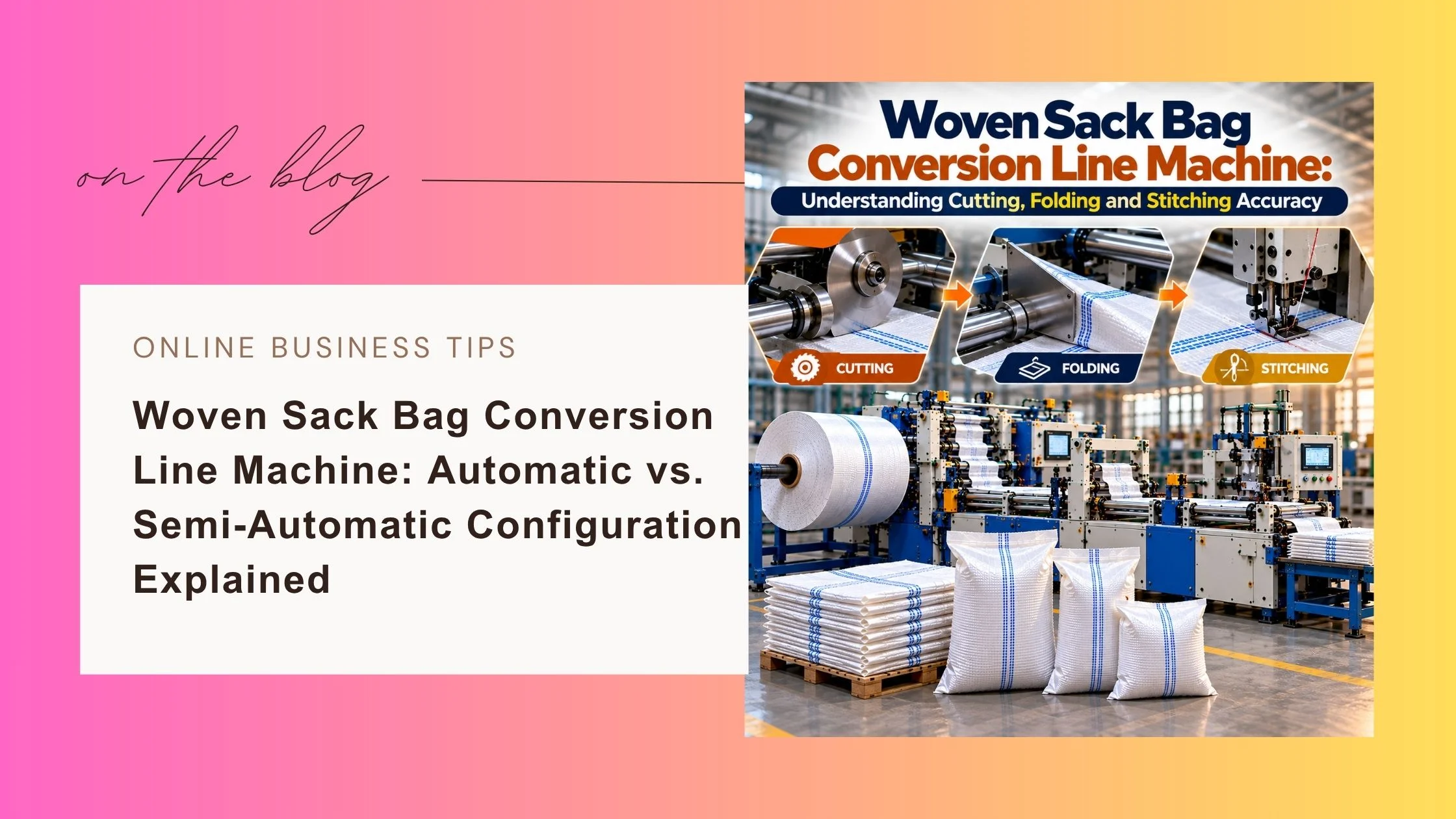
Woven Sack Bag Conversion Line Machine: Automatic vs Semi-Automatic
October 12, 2026
In PP woven sack manufacturing, producing a bag with the correct dimensions and a reliable seam requires more than good-quality fabric. Cutting, folding, and stitching must work together to create a finished product that meets the customer's specifications. Even small variations in these operations can lead to uneven bag dimensions, poorly formed bottoms, inconsistent seams, material waste, and rejected products.
A Woven Sack Bag Conversion Line Machine brings these important operations together in a coordinated production process. Depending on the configuration, the line can automate fabric feeding, cutting, folding, gusseting, stitching, and finished-bag handling. The quality of the final product depends on how accurately these operations are performed and how consistently the machine maintains its settings during production.
For manufacturers supplying fertilizer, cement, food grains, animal feed, chemicals, polymers, and other industrial products, understanding cutting, folding, and stitching accuracy is essential when selecting machinery or improving an existing production line. This guide explains how each process affects finished-bag quality, what manufacturers should inspect, and how the right equipment can support more consistent production.
What Is a Woven Sack Bag Conversion Line Machine?
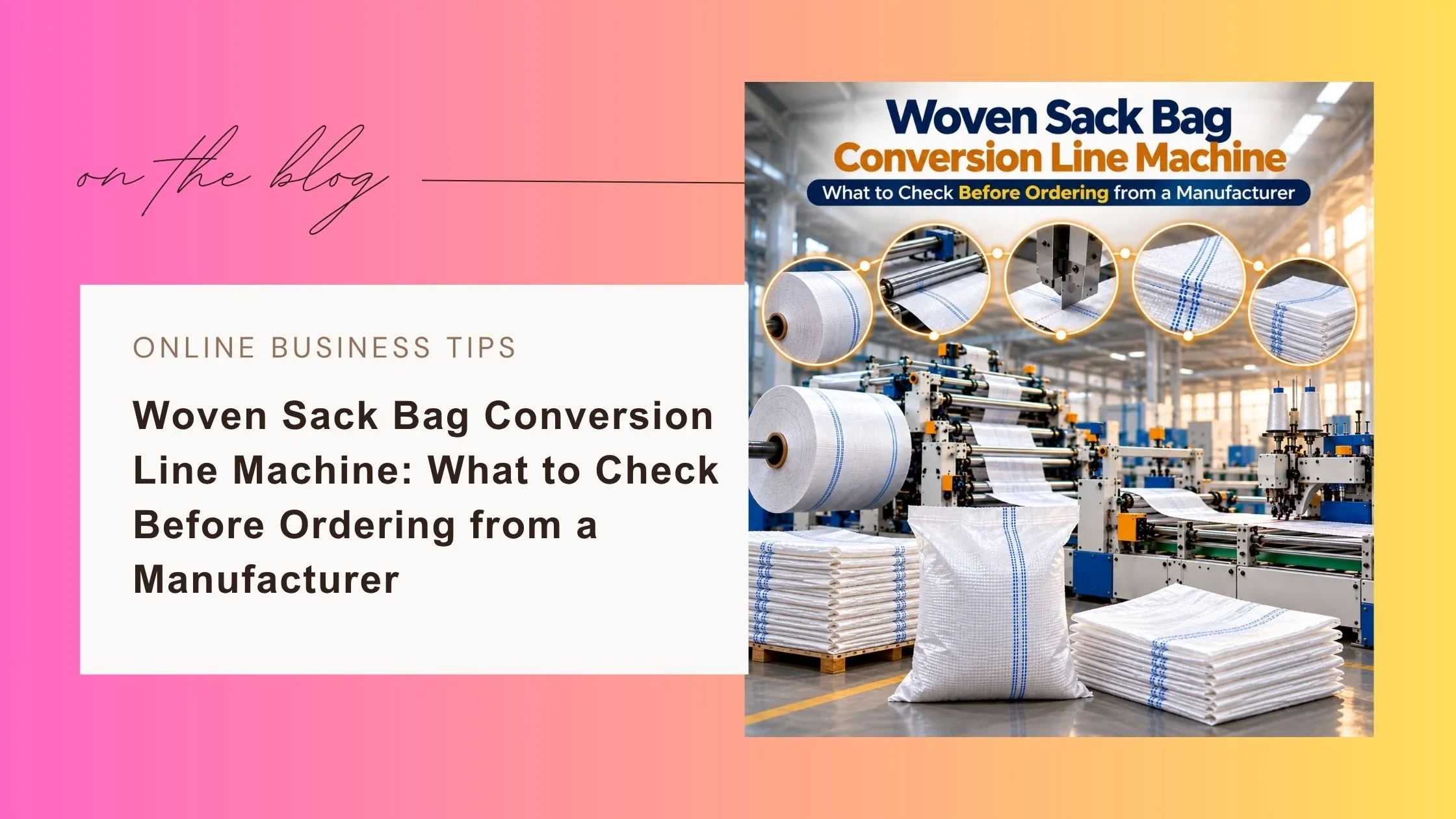
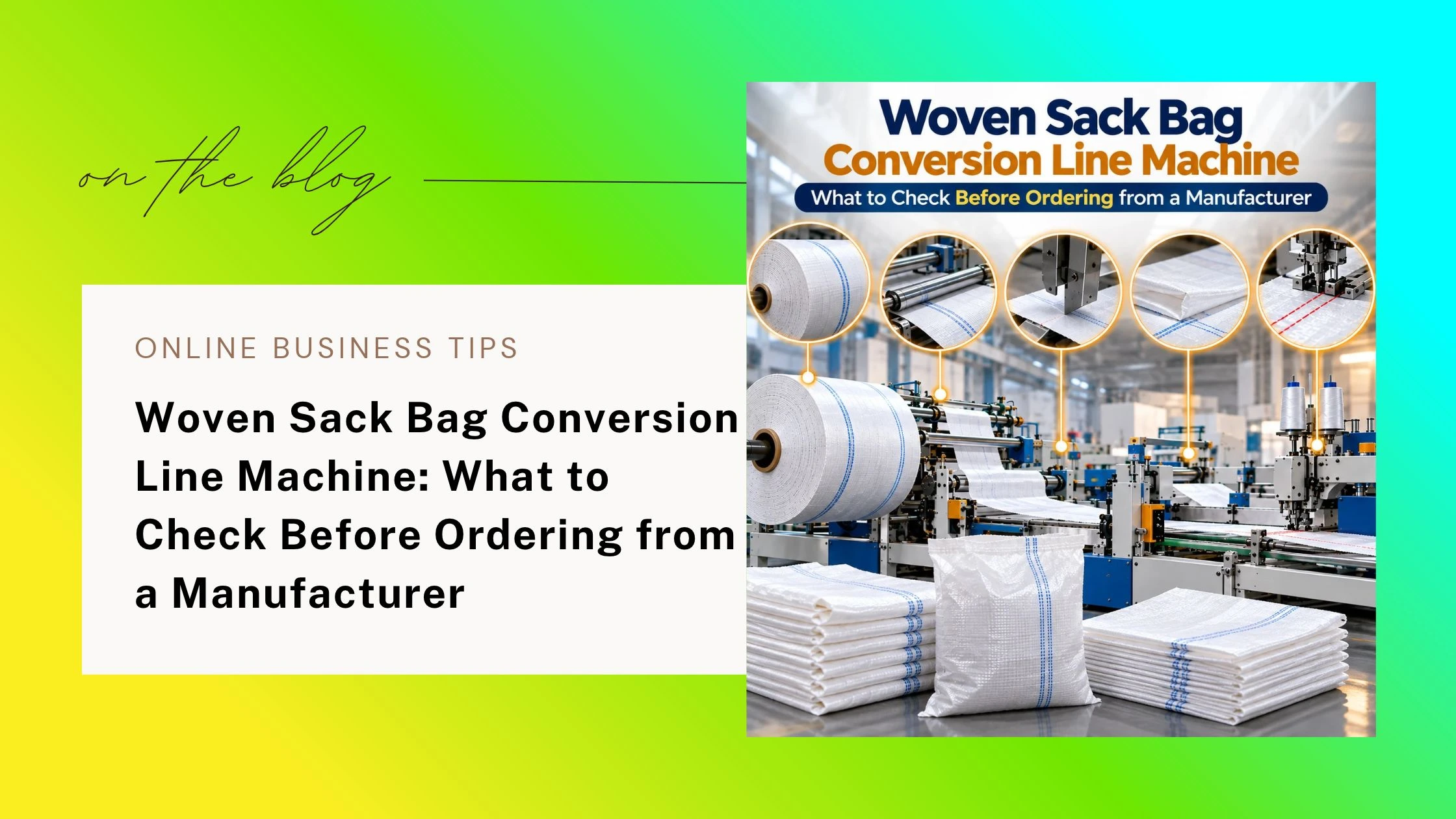
A Woven Sack Bag Conversion Line Machine converts woven polypropylene (PP) fabric into finished sacks through a sequence of manufacturing operations. Depending on the machine design, these operations can include cutting fabric to the required length, folding the bag body, forming gussets, stitching the bottom, and arranging finished bags for collection.
The objective is to transform woven fabric into bags that meet defined dimensional, construction, and quality requirements. An integrated line coordinates multiple operations, helping reduce unnecessary manual handling and maintain a consistent production flow.
However, not every conversion line has the same configuration. A standard open-mouth sack may require a different arrangement from a gusseted or specially constructed bag. Manufacturers should therefore select machinery according to the bag dimensions, fabric characteristics, bottom construction, stitching requirements, and expected production volume.
Oberon Industries offers bag conversion line solutions designed for PP woven and related industrial packaging applications, with configurations intended to support cutting, folding, stitching, and other conversion processes. Explore the Bag Conversion Line to review the machinery solution.
Why Cutting, Folding and Stitching Accuracy Matter
The three operations are closely connected. Cutting establishes the basic dimensions of the bag, folding positions the material for the required construction, and stitching secures the appropriate sections.
If one operation is inaccurate, the next operation may not be able to compensate for the problem. For example, a bag cut to the wrong length may still be folded and stitched successfully, but the finished product can remain outside its dimensional specification.
A reliable Woven Sack Bag Conversion Line Machine should therefore be assessed as an integrated system rather than as separate cutting and sewing components.
Accuracy matters for several reasons. Consistent dimensions support product uniformity, correct folding helps maintain the intended bag shape, and reliable stitching contributes to seam integrity. Together, these characteristics help manufacturers reduce avoidable rework and maintain customer confidence.
The required tolerances depend on the bag design, customer specification, intended use, and applicable product standards. There is no single dimensional or stitching tolerance that applies to every woven sack.
1. Understanding Woven Sack Cutting Accuracy
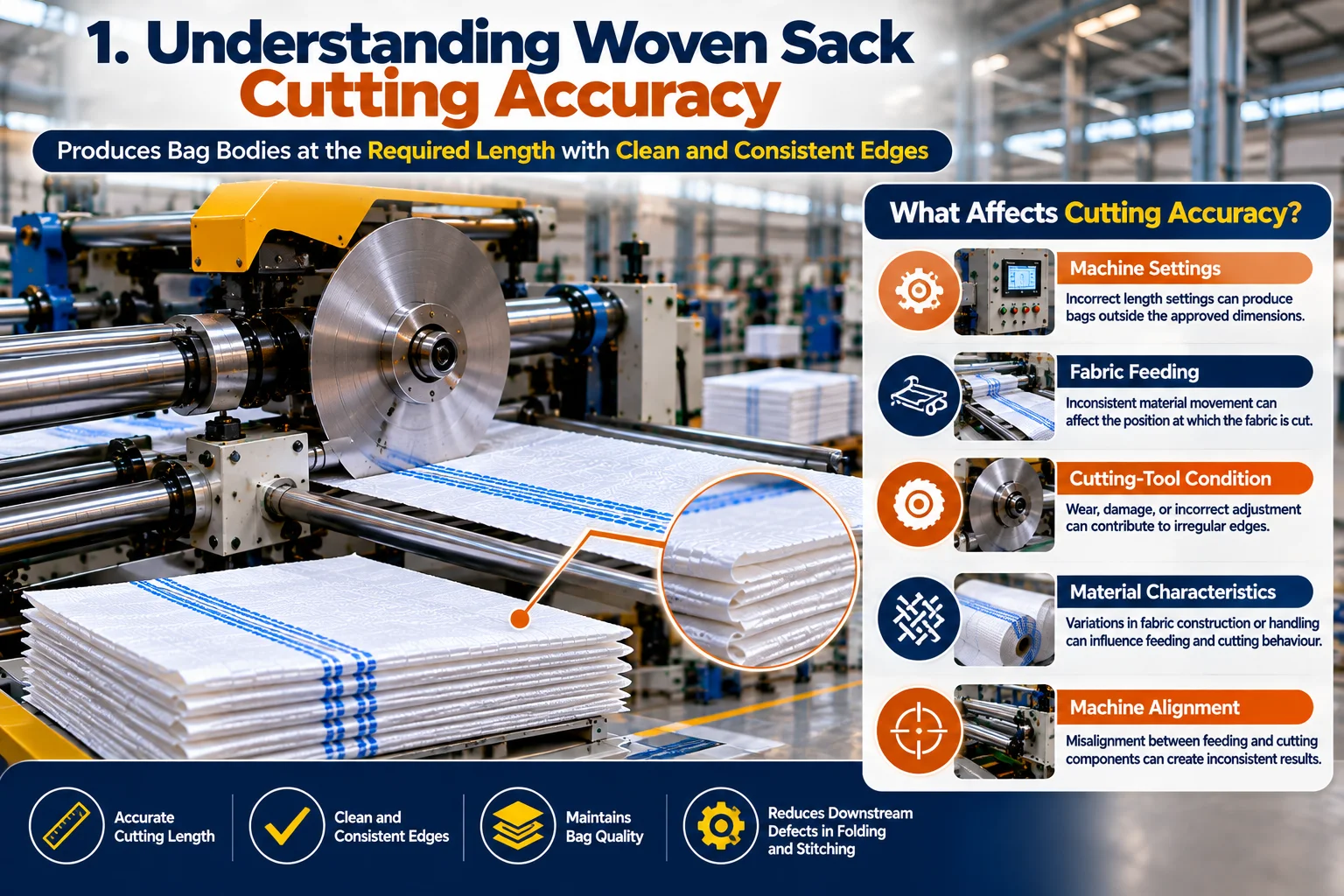
Cutting accuracy determines whether each bag body is produced at the required length and with a clean, consistent edge. It is one of the first critical quality checks in the conversion process because cutting errors can carry forward into folding and stitching.
A suitable Woven Sack Bag Conversion Line Machine should allow the manufacturer to establish and maintain the required cutting length for the selected bag specification.
What affects cutting accuracy?
Several factors can influence the cutting process:
-
Machine settings: Incorrect length settings can produce bags outside the approved dimensions.
-
Fabric feeding: Inconsistent material movement can affect the position at which the fabric is cut.
-
Cutting-tool condition: Wear, damage, or incorrect adjustment can contribute to irregular edges.
-
Material characteristics: Variations in fabric construction or handling can influence feeding and cutting behaviour.
-
Machine alignment: Misalignment between feeding and cutting components can create inconsistent results.
These factors should be investigated systematically whenever repeated cutting defects occur.
How should cutting accuracy be checked?
Manufacturers should measure cut bags against the approved product specification. Initial checks should be performed after machine setup or a product changeover, followed by inspections at intervals established by the factory's quality plan.
Measurements should be recorded so that operators can identify gradual changes rather than relying entirely on visual judgement. If the dimensions begin to drift, the production team can investigate the settings, material movement, tooling condition, and other relevant factors.
2. Understanding Woven Sack Folding Accuracy
Folding determines how the cut fabric is positioned before the next manufacturing operation. Depending on the bag design, folding may create the bottom construction or prepare the material for a gusset or other finishing process.
Woven sack folding accuracy matters because inconsistent folds can affect the final bag shape, seam position, appearance, and dimensions.
Common folding problems
Uneven folds can occur when the material is not aligned correctly, machine guides are incorrectly adjusted, fabric tension is inconsistent, or the folding mechanism is not configured for the required bag specification.
For gusseted sacks, incorrect folding can also create asymmetry between the sides. The resulting bag may not match the intended shape, even when the cutting length is correct.
How to maintain consistent folding
The folding system should be adjusted according to the approved bag design. Operators should check fold position, symmetry, alignment, and repeatability during setup and production.
When a defect appears repeatedly, the team should inspect material tracking, guides, rollers, and relevant machine settings rather than correcting each bag manually.
A suitable Woven Sack Bag Conversion Line Machine should support the folding arrangement required for the manufacturer's actual product range. Buyers should confirm whether the selected configuration handles standard folding, gusseting, or other specific construction requirements.
3. Understanding PP Woven Bag Stitching Quality
Stitching secures the relevant sections of a converted sack. Its quality influences the finished seam's construction, appearance, and ability to withstand the handling conditions for which the bag is designed.
PP woven bag stitching quality depends on the sewing system, thread selection, machine settings, material characteristics, seam placement, and maintenance condition.
What causes stitching defects?
Common problems include skipped stitches, loose threads, inconsistent stitch formation, incomplete seams, incorrect seam positioning, and excessive or insufficient thread tension.
These problems can have different causes. A skipped stitch may require investigation of the needle, thread path, machine timing, or sewing adjustment. A seam positioned incorrectly may instead be associated with material feeding, folding, or alignment.
Operators should avoid assuming that every stitching defect originates in the sewing head. The entire material path should be checked when the problem may have started earlier in the process.
How should stitching be inspected?
Inspectors should compare the finished seam with the approved product specification. Relevant checks may include stitch continuity, seam position, visible thread defects, seam dimensions, and other application-specific requirements.
Where seam strength is critical, visual inspection alone may not be sufficient. Appropriate testing should be selected according to the intended application and governing specification.
For example, ISO 23560:2015 addresses the characteristics, requirements, and test methods for certain woven polypropylene sacks used for bulk foodstuff packaging, including specified 25 kg and 50 kg sacks. The standard was reviewed and confirmed in 2025, so this edition remains current.
How Cutting, Folding and Stitching Work Together
The three processes should be evaluated as connected stages rather than independent operations.
|
Process |
Main accuracy requirement |
Possible defect |
Inspection approach |
|
Cutting |
Correct bag length and consistent edge |
Incorrect dimensions or irregular edge |
Measure length and inspect the cut |
|
Folding |
Correct fold position and symmetry |
Uneven bottom or gusset |
Check alignment and finished shape |
|
Stitching |
Consistent seam placement and formation |
Skipped stitches or incomplete seam |
Inspect stitching and test where required |
|
Material feeding |
Stable movement and alignment |
Position variation across operations |
Check tracking and material handling |
|
Integrated operation |
Consistent coordination between stages |
Repeated defects or production interruptions |
Review process records and inspect output |
The table provides a general inspection framework. The exact acceptance criteria should come from the approved bag specification and any applicable standards.
An accurate cutting process cannot compensate for incorrect folding, and consistent folding cannot guarantee a reliable seam if the stitching setup is unsuitable. The entire production sequence must be controlled.
What Should Manufacturers Check When Selecting a Conversion Line?
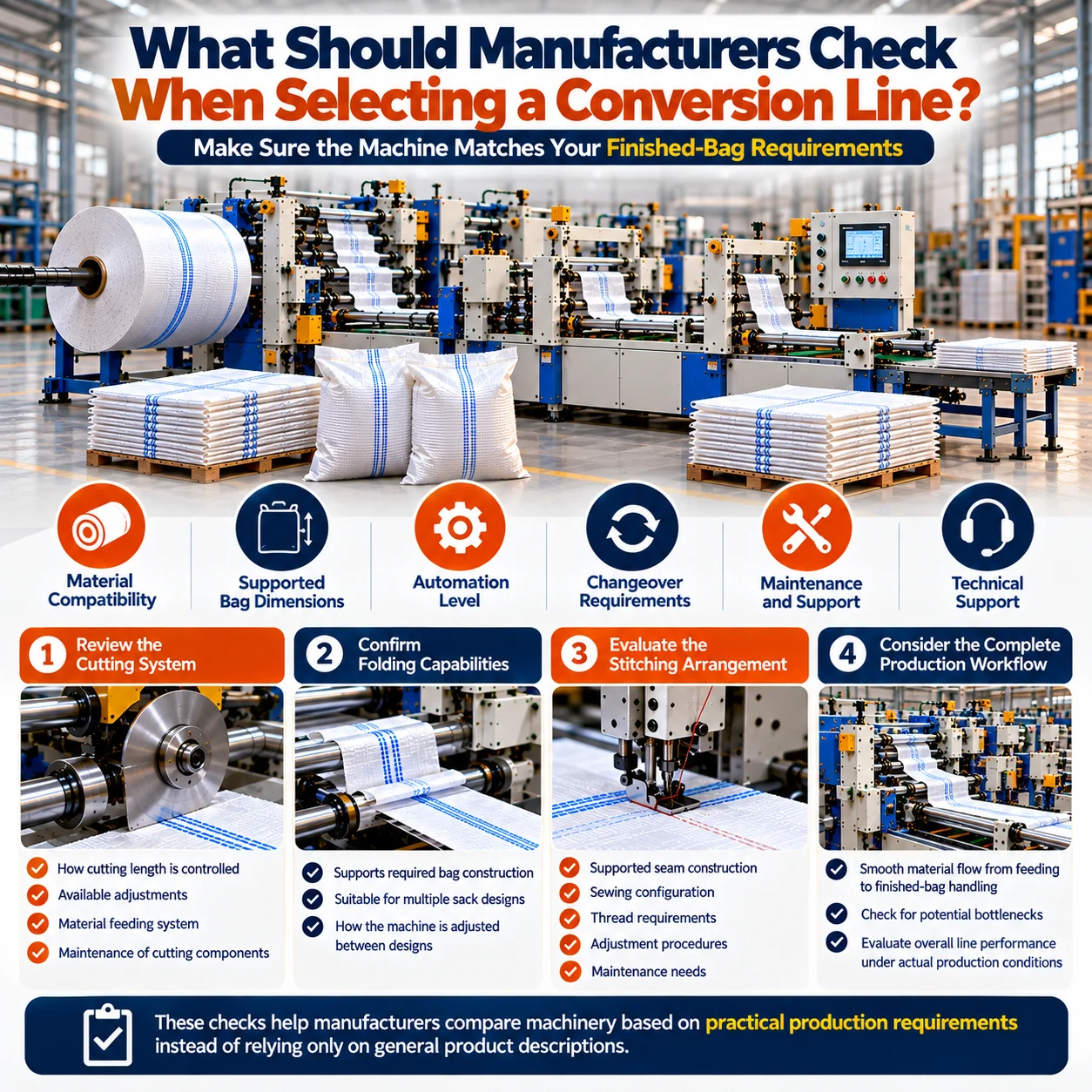
When evaluating a Woven Sack Bag Conversion Line Machine, buyers should focus on how well the proposed equipment matches their finished-bag requirements.
The most important considerations include material compatibility, supported bag dimensions, cutting adjustments, folding or gusseting capabilities, stitching configuration, automation, changeover requirements, maintenance, and technical support.
Manufacturers should also ask how the machine performs under representative production conditions. A headline speed alone does not establish whether the line will maintain the required dimensions and seam quality across every product.
Review the cutting system
Ask how cutting length is controlled, what adjustments are available, how material feeding is managed, and how the cutting components are maintained.
Confirm folding capabilities
Verify that the line supports the required bag construction. If the factory produces several sack designs, understand how the machine is adjusted between them.
Evaluate the stitching arrangement
Confirm the supported seam construction, sewing configuration, thread requirements, adjustment procedures, and maintenance needs.
Consider the complete production workflow
An integrated line should be evaluated for how material moves from feeding through cutting, folding, stitching, and finished-bag handling. A bottleneck in one section can affect the performance of the complete system.
These checks help manufacturers compare machinery on practical production requirements instead of relying only on general product descriptions.
How Automation Supports Better Production Consistency
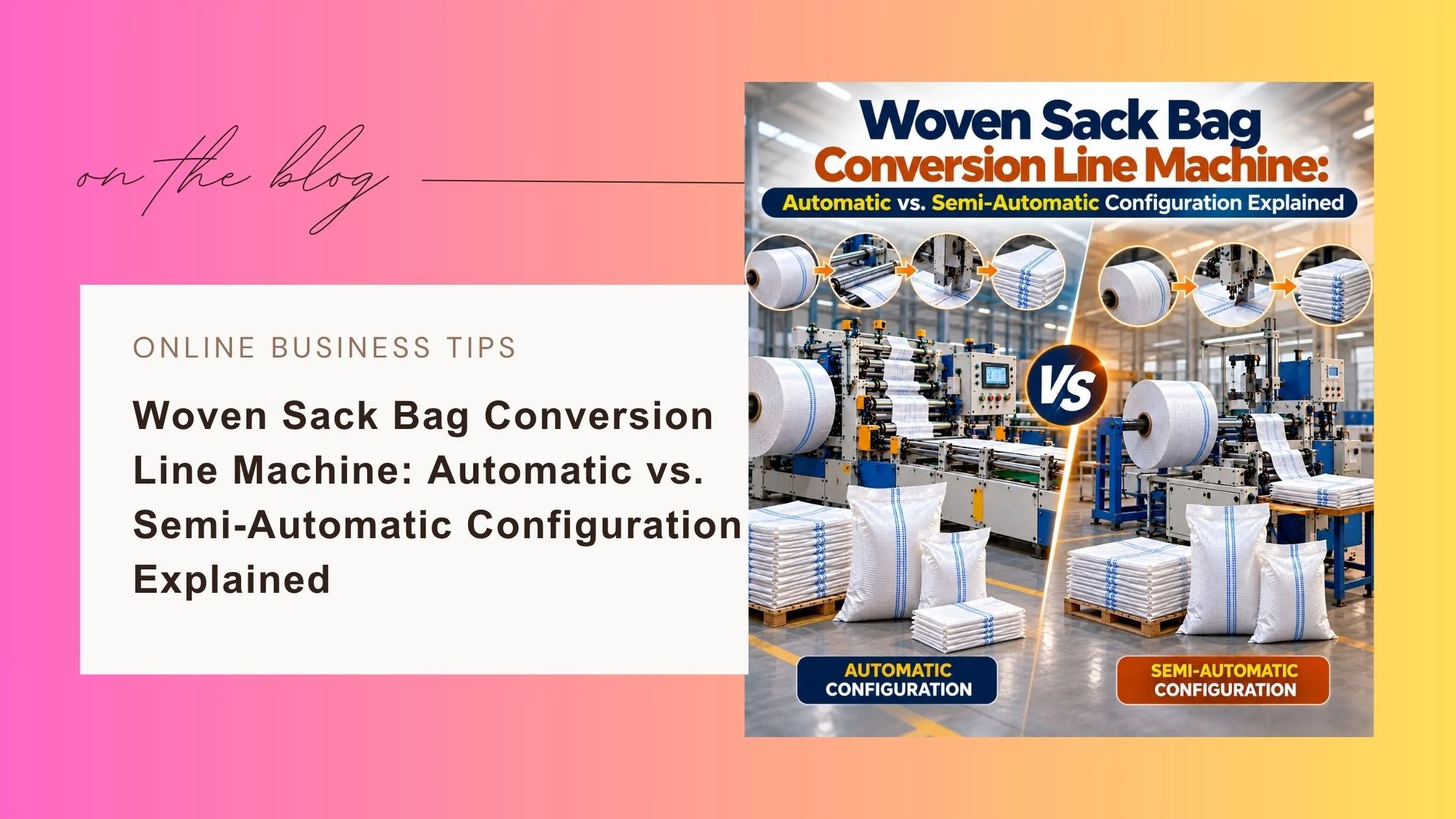
An automatic Woven Sack Bag Conversion Line Machine can coordinate multiple operations and reduce repetitive manual handling. Depending on the configuration, automation can support controlled feeding, cutting cycles, folding, stitching, and finished-bag collection.
Automation can help operators reproduce established settings and maintain a more consistent workflow. It does not, however, eliminate the need for inspection or maintenance. Incorrect settings, unsuitable material, worn components, and poor setup can still produce defective bags.
For this reason, automation should be supported by a documented quality-control plan. The plan should define which characteristics are checked, how results are recorded, how non-conforming bags are separated, and how recurring problems are investigated.
Oberon Industries describes its conversion solutions as supporting processes such as cutting, folding, stitching, gusseting, and other bag-finishing operations. The appropriate configuration depends on the customer's product and production requirements.
Practical Quality-Control Checklist for Woven Sack Production
A consistent inspection routine helps identify defects before they spread through a production run.
-
Confirm the correct material and approved bag specification before production.
-
Check cutting settings and measure initial bags after setup or changeover.
-
Inspect fold position, symmetry, and gusset formation where applicable.
-
Examine stitching for continuity, seam position, and visible defects.
-
Record inspection results and investigate repeated dimensional or seam variations.
-
Verify the finished product against the approved specification before packing.
Inspection frequency should reflect the product requirements, production conditions, historical defect patterns, and the factory's quality-management procedures.
How Maintenance Influences Cutting, Folding and Stitching Accuracy
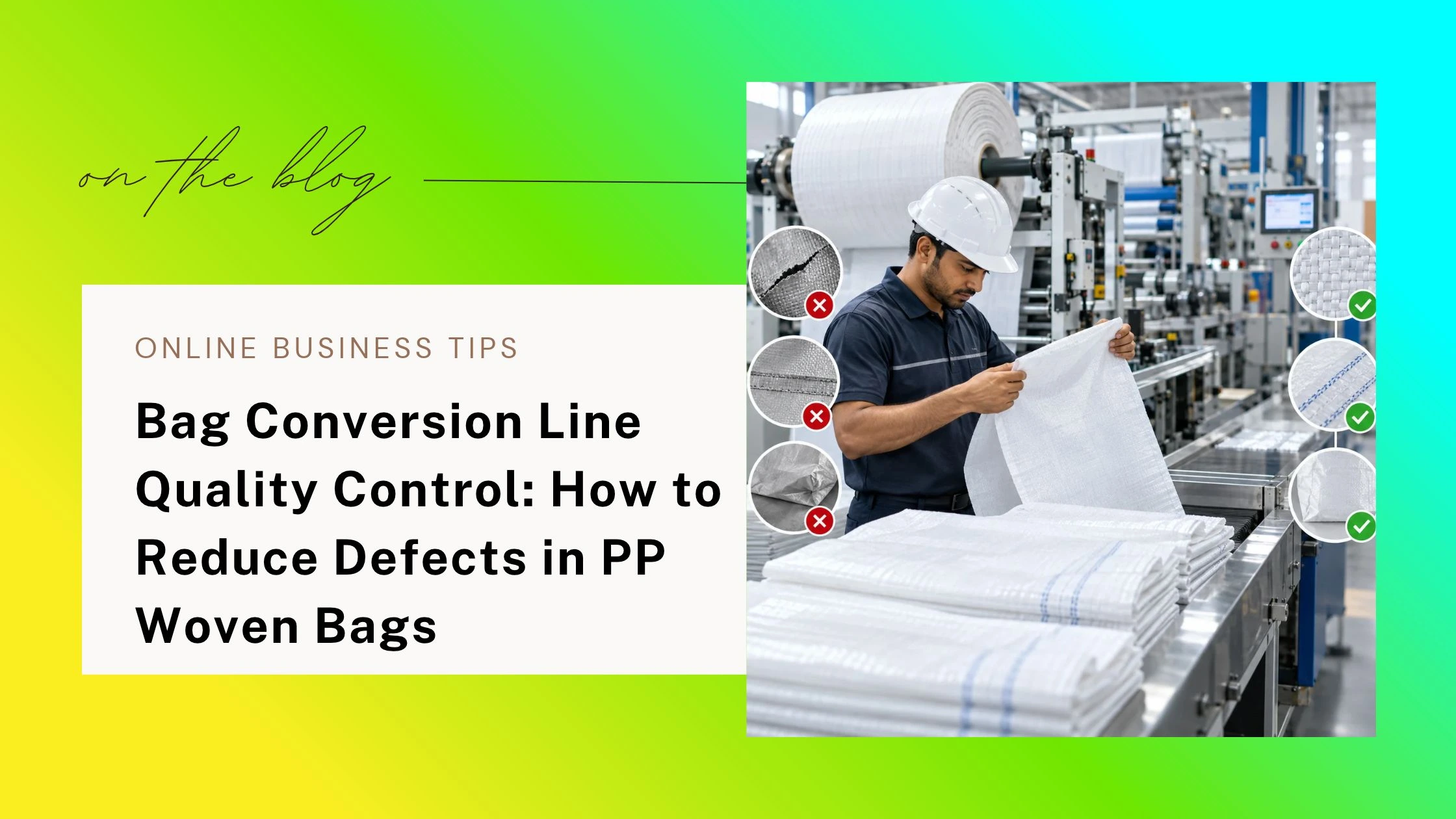
Machine maintenance directly affects the consistency of conversion operations. Worn cutting components may contribute to irregular edges, misaligned guides can affect folding, and poorly maintained sewing components can produce stitching defects.
A preventive-maintenance programme should cover the relevant mechanical components, sewing equipment, sensors, drives, guides, and control systems according to the machine manufacturer's instructions.
Maintenance records are also useful for identifying recurring problems. If the same defect appears repeatedly after a component has been in service for a certain period, the production team can investigate whether inspection or replacement procedures need to be revised.
The goal is not simply to keep the machine running. It is to maintain the operating conditions required for consistent product quality.
How Standards and Product Specifications Affect Accuracy
The required cutting dimensions, fold construction, and seam characteristics depend on the finished sack and its intended use. Buyers should identify the applicable product standard or customer specification before finalising machine requirements.
ISO 23560:2015 is relevant to certain woven polypropylene sacks used for bulk foodstuff packaging. Other applications may be covered by different standards or customer-specific requirements.
Manufacturers should not assume that one specification applies to every PP woven sack. Instead, the production team should document the required bag dimensions, construction details, seam characteristics, inspection methods, and acceptance criteria for each product.
This information can then guide machine selection, setup procedures, inspection plans, and final product approval.
Conclusion
Cutting, folding, and stitching accuracy are fundamental to producing consistent PP woven sacks. Cutting establishes the bag dimensions, folding determines the intended shape and alignment, and stitching contributes to seam quality. When these operations are controlled as one connected process, manufacturers can identify defects earlier, reduce unnecessary rework, and maintain more consistent finished products. Inspection criteria should always match the bag design, customer requirements, and applicable product standards.
Choosing the right Woven Sack Bag Conversion Line Machine begins with understanding the products you intend to manufacture. Evaluate the required dimensions, fabric characteristics, folding or gusseting arrangements, stitching configuration, automation level, and quality-control needs before ordering equipment. Oberon Industries provides bag conversion and industrial bag machinery solutions for manufacturers seeking to improve their woven sack production processes.
Frequently Asked Questions
1. What determines cutting accuracy in a woven sack conversion line?
Cutting accuracy depends on machine settings, fabric feeding, alignment, cutting-tool condition, material characteristics, and the stability of the production process. Manufacturers should measure the cut bags against the approved dimensional specification and investigate recurring variations.
2. Why is folding accuracy important in PP woven bag manufacturing?
Folding accuracy helps maintain the intended bag shape and positions the material correctly for subsequent stitching. Uneven folds can affect the bottom construction, gusset symmetry, seam alignment, and finished appearance.
3. How can manufacturers improve PP woven bag stitching quality?
Manufacturers should use suitable thread and sewing settings, maintain the sewing components, control material feeding, and inspect seam continuity and position. Additional seam testing may be necessary when required by the product specification or intended application.
4. Can an automatic conversion line guarantee defect-free bags?
No. Automation can improve process coordination and repeatability, but product quality also depends on material condition, machine setup, maintenance, operator practices, and inspection. A structured quality-control system remains necessary.
5. What should buyers check before ordering a woven sack conversion machine?
Buyers should confirm material compatibility, supported bag dimensions, cutting controls, folding and gusseting options, stitching configuration, production capacity, automation level, changeover requirements, maintenance access, and after-sales support.
6. Why should cutting, folding and stitching be inspected together?
These processes are interdependent. Cutting establishes the basic bag dimensions, folding positions the material for construction, and stitching secures the required sections. Inspecting them together helps identify the source of defects and prevents problems from passing unnoticed into finished-bag production.